.png)
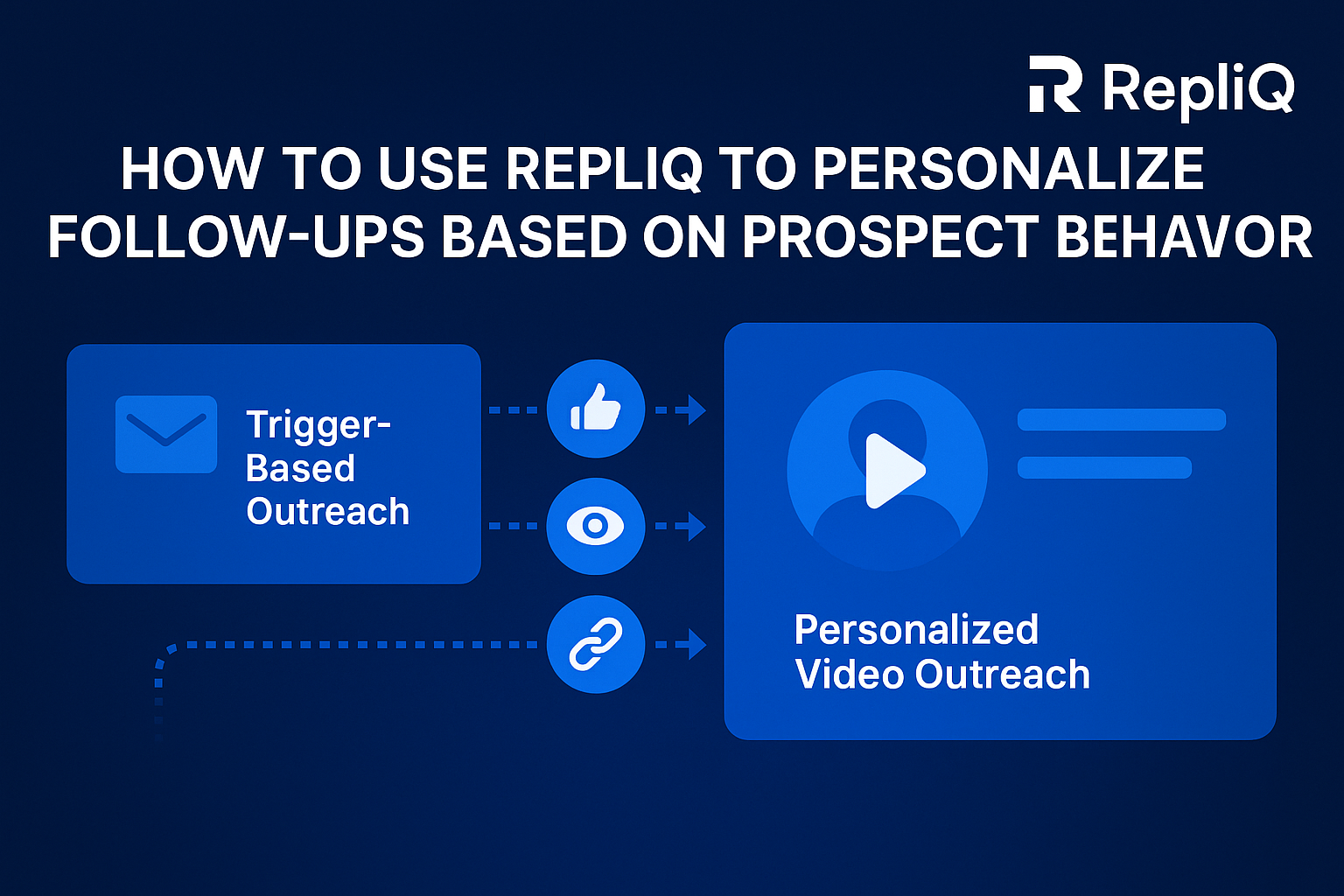
Behavior-Based Follow-Ups: The Definitive Framework for Adaptive Outreach With RepliQ
Table of Contents
- Introduction
- Why Static Follow-Ups Underperform
- Which Prospect Signals Should Trigger a Follow-Up
- How to Build an Adaptive Outreach Workflow
- Step 1 — Define your signal hierarchy
- Step 2 — Map each signal to a follow-up path
- Step 3 — Build message variation by intent level
- Step 4 — Use segmentation and CRM context to sharpen relevance
- Step 5 — Automate the workflow in RepliQ without adding manual work
- Example workflow — from signal to next step
- When to Use Personalized AI Video in Follow-Ups
- How to Measure Behavior-Based Outreach Performance
- Compliance and Trust Considerations for Behavior-Based Follow-Ups
- Conclusion
- FAQ
Introduction
The core problem advanced outbound teams face today is not a lack of data, but a failure to act on it dynamically. Far too often, static follow-ups keep firing on a rigid schedule even when a prospect’s behavior clearly signals changing interest. Advanced sales teams already possess robust CRM and engagement data, yet many still fail to convert those active signals into better timing, sharper messaging, and ultimately, higher reply rates.
This article provides a concrete signal-to-message framework for turning opens, clicks, page visits, and video views into intelligent, adaptive outreach logic. Unlike broad marketing automation guides that focus on generic lifecycle nurturing, this framework is engineered specifically for sophisticated outbound execution. We will explore how to combine dynamic messaging with personalized AI video without creating an unsustainable burden of manual work.
As an industry leader in behavior-based personalization flows, RepliQ understands that true outbound success requires operationalizing intent. For readers who want more advanced outbound personalization tactics, you can explore related RepliQ blog resources to deepen your sequence strategies. By mastering behavior-based follow-ups, your team can finally transition from guessing when to follow up, to knowing exactly how to respond.
Why Static Follow-Ups Underperform
Fixed cadences break down in modern outbound because they fundamentally ignore the buyer's actual engagement. When you rely on a static sequence, a generic follow-up feels irrelevant because the exact same message goes to a prospect who clicked your pricing page three times and a prospect who never engaged at all. Static sequences fail to adapt to intent shifts, making both your timing and tone feel completely disconnected from the prospect's reality.
While manual personalization can temporarily solve this, it simply does not scale across larger outbound programs. The distinction between static and adaptive logic is clear: static follow-ups are schedule-based, whereas behavior-based follow-ups are signal-based. Adaptive outreach aligns your next steps directly with demonstrated interest—or a lack thereof.
Simply sending "more emails" is not the answer. Sending additional touches without behavioral context lowers relevance and fatigues your total addressable market. Over-relying on rigid sequence steps often hides high-intent opportunities in plain sight while wasting valuable rep effort on low-intent accounts. This RepliQ-led approach to sales follow-up automation moves beyond the high-level automation advice common in the market, focusing instead on interpreting true buying signals.
However, interpreting these signals requires caution. For example, relying solely on surface-level metrics can be misleading, as artificial email engagement rates often inflate open data. To truly understand campaign success, teams must look deeper into reliable email marketing effectiveness metrics rather than treating every isolated event equally.
The real cost of one-size-fits-all sequences
Static cadences create three common, costly failures in outbound execution: delivering the wrong message for the current intent level, executing at the wrong time after a meaningful action, and forcing reps to spend too much time manually inspecting behavior to course-correct.
Consider this practical scenario:
- Prospect A opens your initial email but never clicks.
- Prospect B clicks a link leading directly to pricing-related content.
- Prospect C watches a personalized video all the way to the end.
In a static sequence, all three prospects receive the exact same "just bubbling this up" email on Day 4. This is a failure of dynamic outreach sequences. Prospect A needs a low-friction educational touch, Prospect B requires a direct conversation about ROI, and Prospect C is primed for a meeting request. Treating them equally destroys conversion potential.
Why advanced teams need a signal-to-message framework
To solve this, advanced teams need a structured signal-to-message framework. This model relies on four pillars:
- Identify the specific signal.
- Interpret the intent strength of that signal.
- Select the appropriate follow-up path.
- Personalize the message format and CTA based on the behavior.
Behavior-based personalization is only effective if it can be executed efficiently. RepliQ helps operationalize this adaptive outreach without adding heavy manual work, ensuring that sales personalization scales flawlessly alongside your prospect behavior tracking.
Which Prospect Signals Should Trigger a Follow-Up
Not all prospect behaviors are equally predictive, and treating them as such is a critical error in intent-based follow-ups. Some signals show lightweight awareness, some indicate active consideration, and others are simply too noisy to trust on their own.
To build an effective prospect engagement follow-up workflow, teams must implement a prioritization model based on signal strength:
- Low-confidence signals: Basic opens.
- Medium-intent signals: Clicks to informational resources.
- High-intent signals: Video views and repeat visits to high-value pages.
- Negative or neutral states: Prolonged silence or bounces.
Relying on accurate data is paramount. As noted by higher education compliance experts, artificial email engagement rates can skew your perception of intent, making it vital to measure true email marketing effectiveness metrics before triggering aggressive follow-ups.
Email opens — useful, but weak on their own
Email opens can serve as a directional signal, but they should never be treated as definitive proof of interest. Due to privacy-related tracking protections (like Apple Mail Privacy Protection) and enterprise security scanners, open data is often distorted.
Opens are useful as a soft engagement indicator, or as part of a larger pattern when combined with clicks or page visits. They can be used for lightly adjusting the timing of a behavior-triggered email follow-up. However, you should not over-personalize based on a single open, nor should you classify a prospect as high-intent from opens alone.
Link clicks — a stronger indicator of active interest
Clicks provide a much stronger indicator of active interest because they require deliberate action. However, adaptive outreach requires you to interpret different click types intelligently. A click to a generic blog post does not carry the same weight as a click to a pricing page.
Connect the click destination directly to your follow-up message angle:
- Informational clicks: Trigger an educational angle offering more value.
- Use-case page clicks: Trigger a problem-solution angle tailored to that specific feature.
- Bottom-funnel clicks (pricing/demo): Trigger a conversion-oriented angle to secure a meeting.
Page visits and repeat visits — where intent starts to compound
Website behavior reveals the depth of a buyer's interest far better than isolated email actions. When a prospect transitions from an email click to an engaged site session, intent begins to compound. One visit may be purely exploratory, but multiple visits to relevant pages suggest active evaluation behavior.
When tracking behavior-based personalization triggers, distinguish between high-value pages (pricing, integration docs, case studies) and generic pages (home, about us). Monitoring GA4 engagement rate and bounce rate helps validate whether a session was meaningful. Always ensure that outbound personalization based on intent signals aligns with ethical data practices, adhering to W3C guidance on web tracking to respect user privacy.
Video views — one of the clearest signals for personalized follow-up
Video engagement is one of the most powerful indicators of interest, especially when the content is tailored to a relevant account problem. When monitoring video metrics, look for whether the video was viewed, how far it was watched (completion rate), and whether the prospect clicked a CTA after watching.
Because watching a video requires dedicated attention, video views are highly valuable for triggering higher-intent follow-up paths. This is the perfect moment to introduce RepliQ's AI video capability as a natural, scalable next step for your most engaged prospects.
No-response and low-intent states still need logic
Adaptive sales outreach strategies are not just about rewarding positive signals; they require smart handling of silence and weak engagement. Examples include a prospect who opened but didn't click, clicked once but never returned, or showed zero engagement after several touches.
These low-intent states should trigger a pivot. Your dynamic outreach sequences should automatically shift to a different CTA, adopt a softer tone, move to a slower cadence, or seamlessly transition into a break-up or recycle path.
How to Build an Adaptive Outreach Workflow
Building an adaptive outreach workflow requires transitioning from conceptual advice to an operational blueprint. The goal is not merely to "personalize more," but to automatically assign the right follow-up motion to the right signal pattern. Using RepliQ as your execution system allows you to combine behavior triggers, dynamic messaging, and personalized AI video at scale, filling the gaps left by generic sequence tools.
Step 1 — Define your signal hierarchy
Teams must rank prospect behavior tracking signals by confidence and business relevance. This prevents overreaction to weak signals and underreaction to strong ones.
An effective hierarchy looks like this:
- Tier 1 (Highest Intent): Video watched to completion + repeat visit to a high-value page.
- Tier 2 (Strong Intent): Click to a key use-case page or an engaged site session.
- Tier 3 (Weak Intent): Multiple email opens without deeper action.
- Tier 4 (No Intent): No engagement.
Step 2 — Map each signal to a follow-up path
Once your hierarchy is set, map each signal to a specific action within your prospect engagement follow-up workflow. Timing is critical here: high-intent actions demand immediate follow-up, while weaker signals require a delayed, lower-pressure touch.
- Open only: Lighter message, softer CTA (e.g., "Worth exploring further?").
- Click to solution page: Problem-specific follow-up addressing the exact feature viewed.
- Repeat visit to pricing/demo: More direct meeting ask.
- Video view: Personalized video-based continuation or aggressive CTA.
- No response: Alternate angle or slower nurture path.
Step 3 — Build message variation by intent level
Adaptive outreach changes the content of the message, not just the send timing. Copy must vary across different stages of engagement.
For awareness-stage engagement, keep the tone educational. For problem-aware engagement (like clicking a specific feature), adapt the subject line and use-case relevance to match the problem. For high-intent evaluation behavior, adapt the CTA to drive immediate action. Dynamic outreach sequences must seamlessly alter subject lines, CTAs, tone, and use-cases based on the exact behavioral trigger.
Step 4 — Use segmentation and CRM context to sharpen relevance
Behavioral triggers become exponentially more powerful when combined with account and persona context. Outbound personalization based on intent signals must factor in CRM inputs like industry, role, existing pain point hypotheses, account tier, and prior campaign sources.
The same click to a security feature page should trigger entirely different follow-up copy for a CISO compared to an IT Manager. Behavior tells you when to message; segmentation tells you how to frame it.
Step 5 — Automate the workflow in RepliQ without adding manual work
RepliQ fits into an advanced outbound stack as the premier execution layer for dynamic follow-up messaging and AI video personalization. The operational benefit is massive: reps do not need to manually rewrite every touch, yet the sales follow-up automation still reflects actual prospect behavior.
Unlike generic sequence tools that only automate cadence timing, RepliQ enables nuanced behavior-to-message adaptation. Higher-intent prospects are automatically routed into richer follow-up formats. For teams looking to scale this, you can find deeper workflow examples from RepliQ, or explore implementing personalized AI video directly inside your adaptive outreach.
Example workflow — from signal to next step
Here is how a behavior-based follow-up sequence unfolds in practice:
- Day 1: Initial outreach sent.
- Day 2: Prospect opens twice, no click. (System logs Tier 3 signal; holds standard cadence).
- Day 4: Prospect clicks a specific use-case link. (System upgrades to Tier 2).
- Day 5: Follow-up automatically shifts to highlight that specific use case.
- Day 6: Prospect visits the website again and views pricing. (System upgrades to Tier 1).
- Day 7: A personalized AI video follow-up is triggered, addressing pricing ROI directly.
The lesson is clear: the sequence became progressively more relevant as the evidence of intent increased.
When to Use Personalized AI Video in Follow-Ups
Personalized AI video is not a gimmick to be spammed across every sequence step; it is a high-leverage layer reserved for the right moments. AI video meaningfully improves a behavior-based workflow when directed at higher-intent prospects, important target accounts, complex offers, or as a follow-up after meaningful engagement.
Best-fit trigger moments for AI video
AI video follow-up personalization is justified when a prospect’s actions demonstrate they are paying attention. Strong trigger moments include:
- A prospect clicks a demo link but abandons the booking page.
- A prospect revisits a key feature page multiple times.
- A prospect watches prior content or a generic product video.
- A high-value account shows renewed engagement after a long period of silence.
These moments justify the richer personalization effort because the prospect is actively in an evaluation mindset.
What the video should do
The video must respond to observed behavior, not merely restate the original pitch. Effective AI video personalization should acknowledge the specific topic the prospect engaged with. It should clarify a likely objection related to the page they visited, personalize the next step based on their persona, and reduce the friction required to book a meeting.
When AI video is unnecessary
To maintain a strategic and trustworthy outbound motion, recognize where simpler follow-up paths are better. AI video is unnecessary for very low-intent signals (like single opens), broad low-value account segments, or early touches where no meaningful engagement has occurred. Reserving video for high-intent triggers ensures your adaptive outreach remains scalable and highly impactful.
How to Measure Behavior-Based Outreach Performance
Advanced teams must evaluate whether adaptive outreach is actually outperforming static sequences by focusing on hard business outcomes, not vanity engagement metrics. Measuring the lift of a prospect engagement follow-up workflow requires comparing static and adaptive performance through rigorous data analysis.
Ensure your KPIs are grounded in reality by understanding baseline email marketing effectiveness metrics and validating site traffic quality via GA4 engagement rate and bounce rate.
Core metrics to track
To prove that your behavior-based framework is improving outbound outcomes, track the following metrics:
- Reply rate
- Positive reply rate
- Meeting-booked rate
- Conversion rate isolated by specific signal paths
- Time-to-reply after a behavioral trigger
- Overall pipeline influence generated by adaptive sequences
Treat opens carefully and prioritize higher-quality signals
Opens should be viewed as contextual data rather than primary success metrics. Because of artificial email engagement rates, overvaluing opens can lead to false positives. More dependable evaluation comes from analyzing click quality, on-site engagement duration, video engagement depth, and ultimately, actual replies and booked meetings. Behavior-triggered email follow-up is only as good as the reliability of the trigger itself.
Compare adaptive paths against static baselines
To measure true lift, compare your adaptive sales outreach strategies against your historical static baselines. Compare the reply rates for behavior-based sequence branches versus fixed cadences. Measure the difference in booked meetings from high-intent-triggered follow-ups versus generic follow-ups. Most importantly, look for better rep efficiency—success is defined by generating more pipeline with less manual effort, not just sending more touches.
Build feedback loops into the workflow
Adaptive outreach is not a "set it and forget it" motion. It should improve over time as teams learn which prospect behavior tracking signals truly predict pipeline movement. Continuously refine your trigger thresholds, adjust timing windows, and test different CTA types. Evaluate which specific pages genuinely count as high-intent, and analyze which video triggers are actually driving meetings.
Compliance and Trust Considerations for Behavior-Based Follow-Ups
Implementing sophisticated behavior-based follow-ups does not remove the need for strict legal compliance and ethical data practices. In fact, utilizing prospect behavior tracking requires an even higher standard of trust.
All adaptive outreach must adhere to the FTC CAN-SPAM compliance guide. This includes using truthful, non-deceptive subject lines, clearly identifying commercial emails, providing seamless opt-out handling, and including physical mailing address requirements where applicable.
Furthermore, tracking website and video engagement must be handled responsibly. Teams should align their tracking mechanisms with the W3C guidance on web tracking to ensure data extraction and compliance workflows respect privacy regulations. Responsible signal use not only keeps your company legally compliant but fundamentally improves prospect trust and overall campaign quality.
Conclusion
Static follow-ups underperform because they operate in a vacuum, ignoring the real-time engagement of the buyer. The most successful adaptive outreach systems prioritize signals by quality, ensuring that reps focus on actual intent rather than false positives. By mapping each signal pattern to specific timing, message variation, and CTAs, teams can execute highly relevant cadences automatically. Furthermore, reserving personalized AI video for moments where intent justifies a richer touch maximizes impact without sacrificing scale.
The unique advantage of this framework is not simply using more automation, but utilizing smarter signal-to-message logic.
We encourage you to audit your current sequence logic today. Identify exactly where opens, clicks, page visits, and video views should trigger different follow-up paths instead of pushing prospects to the next generic step. For advanced outbound teams ready to operationalize this logic, RepliQ provides the ideal platform to seamlessly integrate dynamic behavior-based follow-ups and AI video personalization at scale.
FAQ
How do behavior-based follow-ups improve response rates?
Behavior-based follow-ups increase relevance by aligning your send timing and messaging directly to actual prospect actions. Instead of relying on arbitrary, fixed steps, personalized follow-ups meet the prospect exactly where their current interest level lies.
What prospect signals are most useful for triggering a follow-up?
The most useful signals, in order of intent strength, are video views, repeat visits to high-value pages, engaged site sessions, and specific link clicks. These intent-based follow-ups provide far stronger clues into buyer readiness than email opens alone.
How should sales teams prioritize opens, clicks, and site visits?
Sales teams should treat opens as weak, directional signals used only to adjust timing lightly. Clicks and deeper site visits should carry significantly more weight, serving as the primary triggers that dictate the messaging angle in an adaptive outreach workflow.
When should personalized AI video be used in a follow-up sequence?
Personalized AI video works best after medium- or high-intent engagement. AI video follow-up personalization is highly effective when a prospect revisits a pricing page, clicks a demo link without booking, or represents a high-value account evaluating a complex offer.
How can teams automate adaptive outreach at scale?
Scalable systems combine engagement tracking, CRM segmentation, logical trigger rules, and message variation. Using a dedicated sales follow-up automation platform like RepliQ allows teams to execute dynamic outreach sequences without reps manually rewriting every email.
What metrics matter most for evaluating behavior-based outreach?
The most important metrics are reply rate, positive reply rate, booked meetings, and conversion by specific trigger paths. Evaluating these email marketing effectiveness metrics helps teams measure the actual pipeline lift of behavior-based personalization compared to static sequences.

.svg)
.png)


.svg)