
Business Valuation Leads: A Personalized Outreach Blueprint for Valuation Firms
Table of Contents
- Introduction: Why Context Matters in Business Valuation Prospecting
- Identify Valuation Triggers and Prioritize Accounts
- Segment Business Owners and Referral Partners
- Create Credible, Role-Specific Outreach
- Build a Repeatable Follow-Up and CRM Workflow
- Measure Qualified Conversations and Pipeline Value
- Tools and Resources for Personalized Financial Prospecting
- Conclusion: Turn Business Context Into Better Valuation Conversations
- FAQ: Business Valuation Leads and Firm Outreach
Introduction: Why Context Matters in Business Valuation Prospecting
Generating qualified business valuation leads requires more than simply downloading massive lists of local businesses. While many valuation firms have access to contact databases filled with business owners and professional advisors, they consistently struggle with a critical missing element: identifying who has a relevant, immediate need for valuation services.
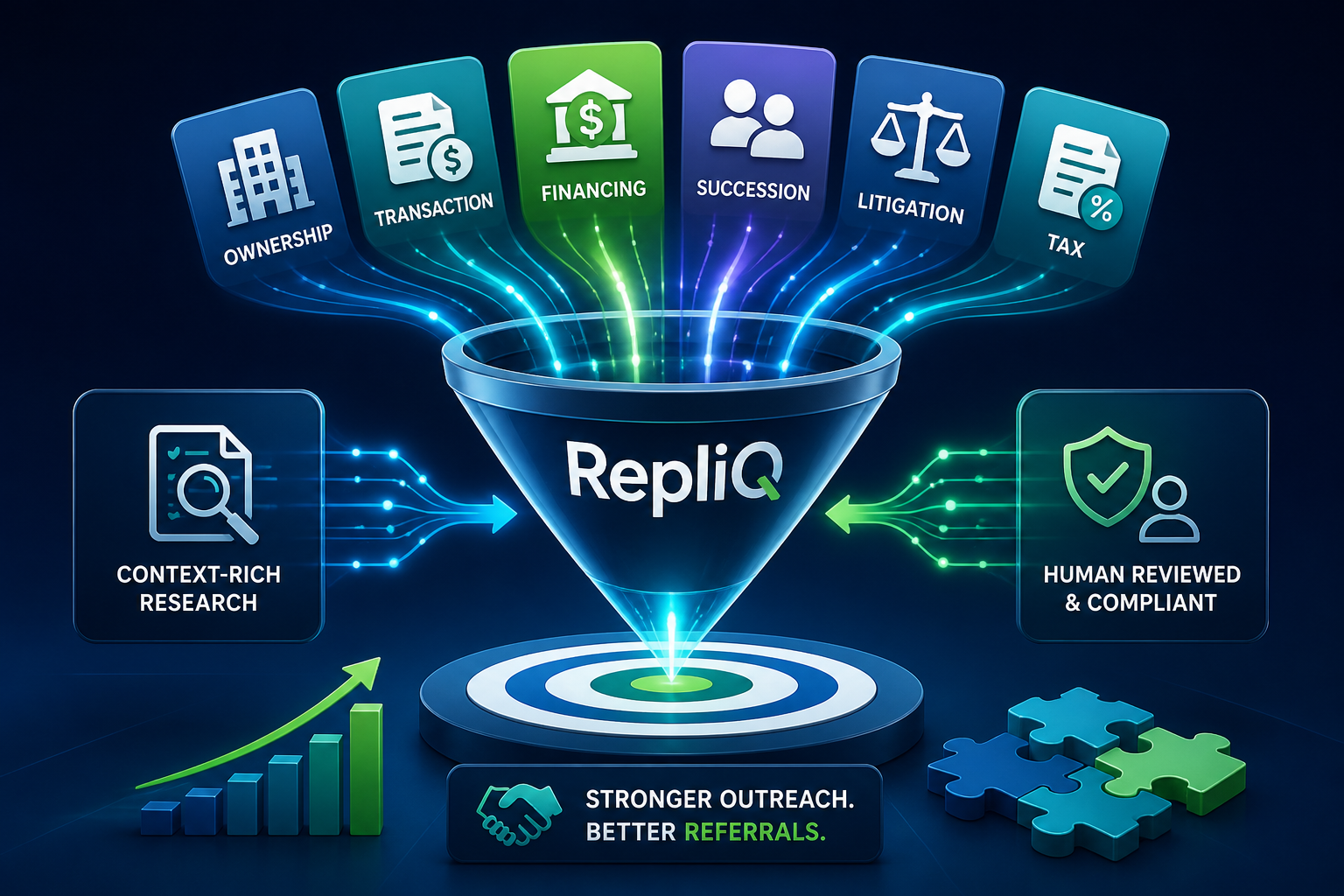
A successful business valuation prospecting strategy relies on timely business context. Legitimate reasons for a valuation conversation are typically born from specific events. Ownership changes, acquisitions, financing rounds, succession planning, litigation, tax planning, and sale preparation all create environments where defensible valuation analysis becomes necessary.
This article provides a repeatable blueprint for turning raw data into actionable intelligence. By building a framework for trigger identification, audience segmentation, personalized outreach, CRM follow-up, and precise measurement, your firm can replace broad, volume-led prospecting with observable signals and human-reviewed messaging.
As a research and prospecting intelligence solution, RepliQ helps professionals assemble this useful context efficiently while preserving human judgment, confidentiality, and compliance. This approach does not guarantee leads, specific valuation outcomes, or investment results. Instead, it ensures that your personalized financial prospecting relies on public or appropriately sourced context to support a hypothesis, never making intrusive assumptions about a prospect’s private finances.
Identify Valuation Triggers and Prioritize Accounts
Moving away from generic industry targeting requires identifying accounts connected to a plausible valuation need. By monitoring the right triggers, firms can dramatically improve their outreach relevance.
Build a Valuation-Specific Trigger Taxonomy
Observable business events act as indicators of a potential valuation use case. While they do not prove that an engagement is required, they provide a highly relevant entry point for conversation.
To systematically capture valuation advisory leads, organize these triggers into practical categories:
- Ownership changes and leadership transitions: Shifts in the C-suite, shareholder activity, or partner buyouts.
- Acquisitions, divestitures, and mergers: Companies actively buying competitors or preparing for a transaction.
- Financing events: Refinancing, capital raises, or new lending activity.
- Succession and exit planning: Aging demographics in ownership, estate planning initiatives, or tax planning. For deeper context on how these events correlate, review the SBA guidance on selling and valuing a business which explains the relationship between selling, ownership transfer, succession planning, and business valuation.
- Disputes and litigation: Shareholder disputes, buyouts, and other situations requiring defensible financial analysis.
Each trigger naturally connects to a specific M&A valuation services conversation, whether it is transaction valuation, dispute support, or strategic tax planning. By mapping business valuation client acquisition efforts to these events, outreach becomes inherently timely.
Distinguish Strong Signals From Weak Signals
Not all data points hold equal weight. Strong evidence is defined as a specific, recent, and relevant public or appropriately sourced event directly connected to a plausible valuation use case.
Conversely, weak signals include mere industry membership, company size, generic growth language in a press release, or an outdated job change. A trigger simply creates a research hypothesis—it is not a definitive conclusion about the company’s finances, intentions, or readiness to buy.
When evaluating transaction advisory prospects, exit planning prospects, or succession planning leads, adhere to a strict “do not infer” checklist. Never assume or reference:
- Confidential financial information.
- Undisclosed transactions or quiet M&A explorations.
- Personal motivations (e.g., assuming an owner is retiring solely based on age).
- Urgency that has not been publicly stated.
Score and Prioritize Accounts
To streamline your financial services lead generation, implement a simple account-prioritization model. Score accounts based on:
- Trigger relevance: How closely the event ties to a valuation need.
- Trigger recency: Events within the last 30 to 90 days score highest.
- Evidence quality: Publicly verified filings or announcements versus rumors.
- Likely valuation use case: The specific service line required.
- Accessibility: The ability to reach the appropriate decision-maker or referral partner.
Separate high-priority accounts from nurture accounts. If timing or evidence is unclear, move the account to a nurture track. Use a sample qualification checklist before outreach:
- Confirm company profile and ownership structure.
- Identify the likely valuation purpose.
- Document the trigger date and source.
- Pinpoint the relevant decision-maker or influencer.
- Assess the referral opportunity.
- Set the next action and review date.
This structured approach ensures your deal sourcing for valuation firms focuses only on the most viable business valuation leads.
Segment Business Owners and Referral Partners
Valuation-firm outreach must distinguish direct buyers from the professionals who influence or refer valuation engagements. Sending the same message to a founder and a CPA will inevitably suppress response rates.
Direct Prospects: Owners, Founders, CFOs, and Shareholders
Business owners and executives face unique pressures. Their primary concerns typically revolve around:
- Understanding company value before a sale or transition.
- Preparing for succession or an internal ownership transfer.
- Evaluating a transaction, buyout, or major financing decision.
- Supporting tax, estate, or shareholder planning requirements.
When executing business valuation marketing toward direct prospects, first-touch outreach should lead with education or a relevant question rather than an aggressive pitch. Frame your firm’s capabilities around clarity, defensibility, sector knowledge, and practical deliverables. By offering insight into exit planning business valuation, you position the firm as an advisor rather than a vendor, which is the most effective method for how to get valuation clients.
Referral Partners: CPAs, Attorneys, Lenders, Wealth Advisors, and M&A Professionals
Referral partners do not typically need a valuation themselves, but they are uniquely positioned to identify clients who do. A robust CPA referral network for valuation firms or an M&A advisory prospecting strategy requires addressing role-specific contexts:
- CPAs: Focused on tax planning, ownership transitions, estate matters, and financial reporting support.
- Attorneys: Focused on shareholder disputes, litigation, buyouts, and transaction support.
- Lenders: Focused on financing, underwriting, ownership changes, and business-risk discussions.
- Wealth advisors: Focused on liquidity events, concentrated ownership, succession, and estate planning.
- M&A advisors and investment bankers: Focused on transaction preparation, fairness considerations, and deal support.
Outreach to these business valuation referral sources must emphasize responsiveness, qualifications, scope clarity, confidentiality, and ease of referral. It is highly recommended to align your messaging with professional standards, such as referencing AICPA valuation standards when discussing professional judgment, engagement scope, reporting considerations, and defensible valuation work.
Match the Message to the Role and Likely Use Case
To systemize this segmentation, create a role-to-message matrix containing the following columns:
- Audience
- Observable trigger
- Likely concern
- Appropriate educational angle
- Suggested next step
The same trigger—such as a recent capital raise—should not produce identical messaging for an owner, a CPA, and an attorney. Broad contact-volume strategies associated with general-purpose databases fail precisely because they ignore this nuance.
Successful financial advisor prospecting strategies and valuation firm outreach rely on competitive differentiation: valuation-specific interpretation, role-based messaging, and human review. Personalized financial prospecting ensures that outreach resonates with the recipient's specific professional lens.
Create Credible, Role-Specific Outreach
Turning research signals into relevant first-touch messages requires a framework that leverages context without overstating what is known.
Use a Research-to-Message Framework
Structure every outreach message around five core elements:
- Verified business context: A publicly sourced event.
- Valuation-related relevance: Why this event matters now.
- Restrained expertise: A brief, factual statement of your firm’s capabilities.
- Educational resource or question: A low-friction offer of value.
- Low-pressure next step: An invitation to connect, not a demand for a meeting.
The difference between useful and superficial personalization is stark. Useful personalization references a relevant business event and explains why it matters. Weak personalization simply inserts a company name or industry into a generic template. As noted in Stanford research on email personalization, testing recipient-relevant personalization is far more effective than assuming all forms of personalization automatically improve performance. This targeted business valuation prospecting ensures higher credibility and response rates for valuation firm outreach.
Outreach Templates by Audience
Adaptable templates—not rigid scripts—allow for necessary customization.
Business Owner or Founder Template
Carefully reference the relevant public business context. Connect this context to a possible planning, transaction, succession, or ownership question. Never state that the owner is selling or facing a financial issue unless publicly confirmed. Offer an educational conversation, a valuation-planning checklist, or a brief discussion of possible next steps to secure business valuation client acquisition and engage exit planning prospects regarding succession planning valuation.
CPA or Tax Advisor Template
Focus on coordination, timing, documentation, and the role of valuation in tax or ownership planning. Emphasize clear scope, defensible analysis, and seamless communication with the client’s existing advisors. Ask whether valuation support is useful for current or upcoming client situations to generate valuation advisory leads and expand your CPA referral network for valuation firms, particularly regarding valuation for estate and gift tax.
Attorney Template
Focus on shareholder matters, litigation, buyouts, marital or ownership disputes, and transaction support. Avoid implying that a specific dispute exists unless the source supports that conclusion. Emphasize confidentiality, independence, defensibility, and responsiveness to attract transaction advisory prospects and establish reliable business valuation referral sources for valuation for shareholder disputes.
Lender, M&A Advisor, or Wealth Advisor Template
Connect the message to financing, acquisition, liquidity, succession, or transition planning context. Explain how a valuation specialist supports a broader advisory process. Offer a referral conversation or capability overview instead of assuming an active engagement to enhance M&A advisory prospecting, financial advisor prospecting strategies, and M&A valuation services.
Personalize Without Making Unsupported Assumptions
Maintaining trust requires a “safe personalization” checklist:
- Use observable context.
- Name the possible relevance, not a presumed need.
- Use qualifying language ("may," "could," "if relevant").
- Invite correction from the recipient.
- Never reference sensitive or nonpublic information.
Lead with education instead of a sales request. Any message containing financial, ownership, litigation, tax, or transaction-related context must undergo human approval. It is critical to maintain technically grounded conversations; refer to IRS business valuation resources to ensure fair-market-value context is accurately framed.
Compliant financial prospecting is paramount. While RepliQ supports research and workflow efficiency for personalized B2B outreach for professional services, it does not replace valuation expertise, professional judgment, or confidentiality review when pursuing business valuation leads.
Build a Repeatable Follow-Up and CRM Workflow
To transform one-off research into an accountable operating system for business development, valuation firms must implement a structured CRM workflow.
Define CRM Fields and Workflow Stages
Standardize your data capture to support financial services lead generation. Recommended CRM fields include:
- Account name and business profile.
- Contact role and relationship type.
- Trigger category, source, date, and evidence quality.
- Possible valuation use case.
- Referral source or partner relationship.
- Personalization notes and approval status.
- Last contact, next action, and follow-up date.
- Outcome, opportunity stage, and estimated pipeline value.
Map this data to a simple, repeatable workflow:
- Identify the account.
- Verify the context.
- Map decision-makers and influencers.
- Assign a trigger and use case.
- Draft and review outreach.
- Send and follow up.
- Qualify, nurture, refer, or recycle.
To streamline this process, Introduce RepliQ as a workflow aid for assembling prospect context, organizing research, and supporting more consistent outreach. By centralizing business valuation prospecting data, valuation firm outreach becomes highly systematic.
Add Human Review and Compliance Checkpoints
Automation is powerful but must be applied carefully. AI-assisted prospecting can handle:
- Account research organization.
- Trigger categorization.
- Contact mapping.
- Draft personalization.
- Reminder and task creation.
However, professional review is strictly required to determine:
- Whether a signal is accurate and sufficiently relevant.
- Whether the message could inadvertently reveal sensitive information.
- Whether the use case is appropriate to mention.
- Whether the recipient and channel are suitable.
- Whether the claims reflect the firm’s actual qualifications.
Always utilize a compliance checklist covering sender identity, truthful subject lines, opt-out handling, and outreach decision records. For comprehensive guidance on compliant financial prospecting and personalized financial prospecting, adhere strictly to the FTC commercial email compliance guide.
Create a Practical Follow-Up Cadence
A fixed, high-volume sequence is inappropriate for valuation services. Instead, build follow-up stages based on recipient response and timing. Create distinct paths for:
- Interested direct prospects.
- Interested referral partners.
- No response, but a relevant, verified trigger.
- Timing not yet appropriate (nurture).
- Incorrect contact or redirected referral.
- Opt-out or do-not-contact request.
Provide useful follow-up assets, such as a valuation planning checklist, trigger guide, case-based explanation, or a short capability overview. To see how research, segmentation, and follow-up workflows can support your business valuation client acquisition and business valuation referral sources, explore relevant RepliQ use cases. Additionally, Scaliq.ai serves as a related resource for scalable intelligence workflows, though automation never replaces professional review or valuation firm outreach judgment.
Measure Qualified Conversations and Pipeline Value
Vanity metrics like open rates do not reflect the economics or trust-based nature of valuation services. Measurement must focus on pipeline value.
Track Outcomes That Matter to Valuation Firms
Prioritize metrics that indicate genuine interest and business valuation leads generation:
- Qualified conversations.
- Referral introductions.
- Meetings with relevant decision-makers.
- Meeting-to-engagement conversion.
- Opportunity-to-engagement conversion.
- Expected and realized pipeline value.
- Time from trigger identification to conversation.
- Revenue or engagement value by trigger type.
Opens, clicks, and raw reply volume are secondary indicators. A high reply rate consisting of irritated prospects is detrimental. Success in financial services lead generation and valuation client acquisition is defined by the transition from a positive response to a qualified conversation, a referral opportunity, and ultimately, an actual valuation engagement.
Attribute Results to Triggers and Referral Sources
To optimize deal sourcing for valuation firms, report results by specific categories:
- Ownership or leadership transition.
- Acquisition or divestiture.
- Financing or capital event.
- Succession or exit planning.
- Litigation or shareholder matter.
- Tax or estate planning.
- Referral-partner category.
Track which sources produce the strongest conversations, not just the largest lists. Conduct a monthly review of your business valuation marketing and valuation advisory leads: Which triggers produced qualified opportunities? Which messages generated useful replies? Which referral partners introduced prospects? Where did research create false positives? Which accounts should be recycled or removed?
Improve Through Controlled Testing
Continuous improvement requires testing one variable at a time:
- Trigger framing.
- Role-specific value proposition.
- Educational offer versus meeting request.
- Subject line.
- Follow-up timing.
- Referral-partner versus direct-owner CTA.
Always conduct a quality review of replies to ensure that higher response rates are not the result of less accurate or overly intrusive messaging. Feed these testing results back into your trigger taxonomy, qualification scores, templates, and CRM workflow to continually refine your personalized financial prospecting, financial advisor prospecting strategies, and overall business valuation prospecting.
Tools and Resources for Personalized Financial Prospecting
General-purpose prospecting tools have their place, but they must fit into a valuation-specific process rather than acting as a standalone strategy.
Use Discovery and Contact Tools as Inputs, Not the Strategy
Platforms like LinkedIn Sales Navigator, Apollo, and other contact-data or enrichment tools are excellent for account discovery, contact identification, saved searches, sequencing, or workflow execution. However, there is a massive strategic gap: finding a contact’s email address does not establish a valuation need or provide a credible reason for outreach.
General-purpose tools may require additional interpretation to connect data to valuation-specific use cases. Contrast broad contact-volume workflows with RepliQ’s context-led approach, which emphasizes trigger identification, valuation-specific interpretation, role-based messaging, human review, and referral attribution. This ensures that valuation firm outreach generates highly relevant business valuation leads through personalized financial prospecting.
Create a Valuation Outreach Resource
To support organic traffic and lead capture for how to get valuation clients, create a downloadable asset such as a “Business Valuation Trigger-Monitoring Checklist,” a “Referral-Partner Outreach Brief,” or a “Valuation Prospect Qualification Worksheet.”
Suggested fields for these resources include:
- Trigger category.
- Evidence source.
- Likely valuation use case.
- Relevant role.
- Safe outreach angle.
- Compliance review.
- Follow-up date.
For firms that want to organize context-rich research and streamline business valuation marketing and business valuation referral sources, use this practical next step to organize context-rich research and prospecting activity with RepliQ.
Conclusion: Turn Business Context Into Better Valuation Conversations
Generating high-quality business valuation leads requires a systematic shift from volume to relevance. By implementing this five-part system, valuation firms can transform raw data into a predictable pipeline:
- Identify observable valuation triggers.
- Prioritize accounts using relevance, recency, and evidence quality.
- Segment owners from referral partners.
- Create role-specific, restrained outreach.
- Track qualified conversations and pipeline value.
The ultimate goal of business valuation client acquisition is not to accumulate more contacts; it is to generate more timely, credible, and relevant conversations. AI-assisted research and workflow automation should always support—never replace—valuation expertise, confidentiality, compliance, and professional judgment.
Take action today: review your firm’s current trigger taxonomy, download a valuation outreach checklist, or explore how RepliQ can support a repeatable prospecting workflow to elevate your valuation firm outreach.
FAQ: Business Valuation Leads and Firm Outreach
What makes a business valuation lead qualified?
A lead is qualified based on a relevant business context, a plausible valuation use case, an appropriate contact or referral relationship, timing, and a willingness to discuss the situation. Company size or industry alone does not make qualified business valuation leads or valuation advisory leads.
Which business events create potential valuation opportunities?
Key events include ownership changes, acquisitions, divestitures, financing, succession, sale preparation, shareholder disputes, litigation, tax planning, and estate planning. Signals should always be verified and treated as hypotheses rather than absolute proof of a need, driving effective business valuation prospecting, succession planning valuation, and valuation for mergers and acquisitions.
How should outreach differ between business owners and referral partners?
Owners typically care about planning, value clarity, transitions, or transaction decisions. Referral partners care about technical support, responsiveness, defensibility, confidentiality, and client coordination. Recognizing this difference is crucial for engaging business valuation referral sources through personalized financial prospecting and tailored valuation firm outreach.
How can valuation firms personalize outreach without making intrusive assumptions?
Use observable context, qualifying language, transparent source logic, and low-pressure questions. Never imply knowledge of private finances, undisclosed transactions, or personal motivations. This ensures highly compliant financial prospecting and effective personalized B2B outreach for professional services.
What should valuation firms measure beyond email replies?
Firms should track qualified conversations, referral introductions, meeting-to-engagement conversion, pipeline value, time to conversation, and outcomes by trigger type. Reply volume alone can reward inaccurate or poorly targeted outreach, undermining valuation firm lead generation, financial services lead generation, and business valuation client acquisition.
Author and Brand Note: RepliQ helps valuation firms and professional-service teams organize business context, prioritize accounts, and support personalized prospecting workflows. This framework is explicitly designed to preserve human review, confidentiality, compliance, and professional judgment. For more information, explore RepliQ use cases and Scaliq.ai. Qualified valuation professionals remain entirely responsible for engagement decisions, technical analysis, client communication, and final deliverables. All data use must remain legal, ethical, and fully compliant with privacy regulations.


