.png)
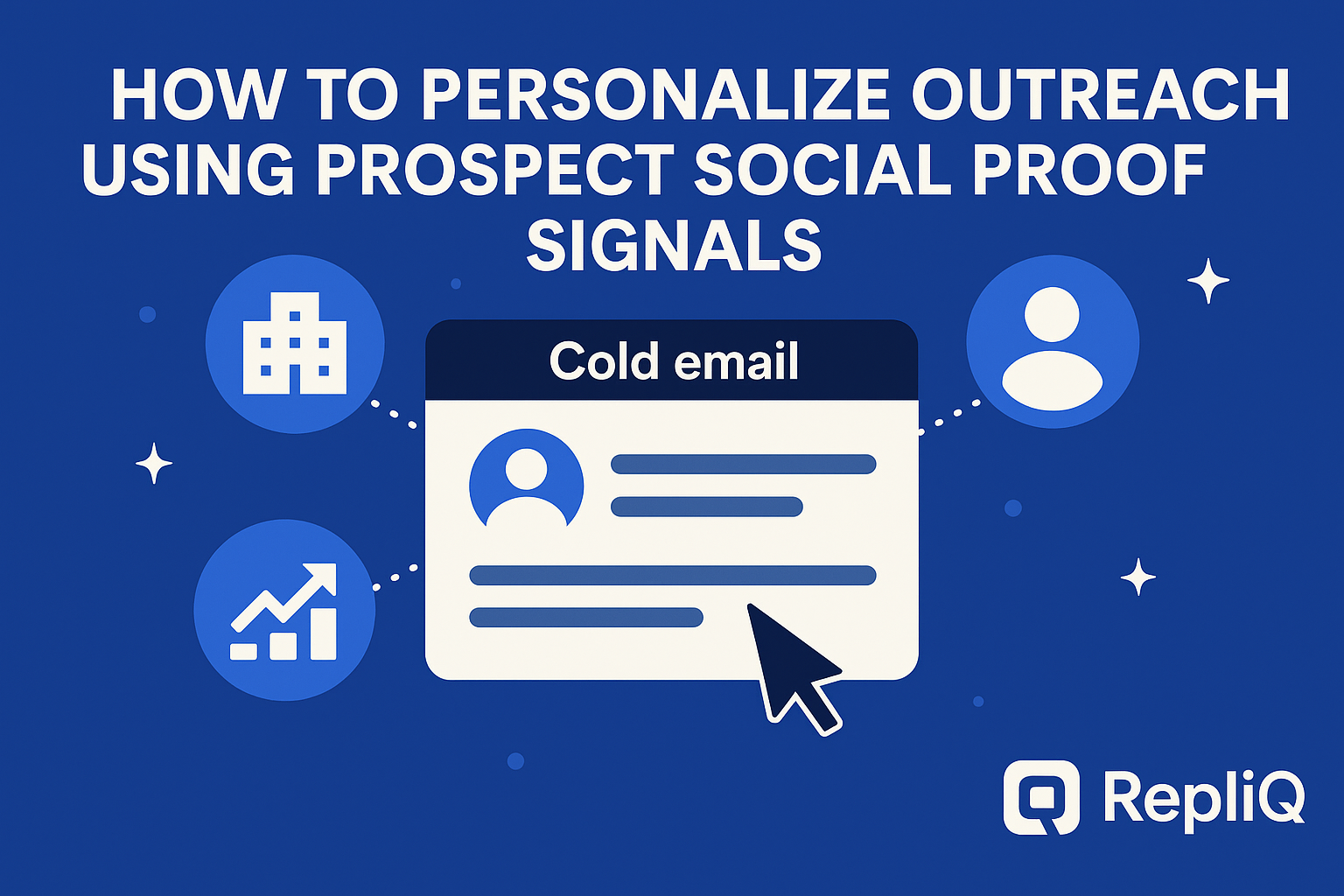
Social Proof Personalization: The Definitive Blueprint for Better Outreach Using Public Signals
Table of Contents
- Introduction
- What Social Proof Personalization Means
- The Best Public Signals to Use in Outreach
- How to Turn Signals Into Natural Opening Lines
- Scaling Personalization With Workflows and AI
- How to Stay Authentic, Privacy-Safe, and Measurable
- Future Trends in Social-Proof-Based Outreach
- Conclusion
- FAQ
Introduction
Generic outreach gets ignored because it lacks relevance, timing, and credibility. When an inbox is flooded with automated templates, buyers instinctively filter out anything that doesn't immediately demonstrate an understanding of their specific world. For SDRs, sales reps, and outbound teams, the challenge is clear: you need to improve reply rates without spending hours on manual prospect research for every single contact.
This article is a practical guide that bridges the gap between signal discovery and real outreach execution across email, LinkedIn, and personalized video. Instead of relying on broad personalization advice, we will explore a unique angle: how company-level, person-level, and market-level social proof can be transformed into highly effective, channel-specific opening lines.
By mastering social proof personalization, teams can achieve a rare balance in outbound sales—building immediate trust while maintaining the speed and scalability required to hit targets. Based on RepliQ’s extensive experience powering personalized outreach and crafting personalized lines, we know that the right public signals can dramatically shift how prospects perceive your message. For more insights on building effective outbound strategies, our INTERNAL_LINK: https://repliq.co/blog serves as a comprehensive resource hub for outreach and personalization best practices.
What Social Proof Personalization Means
Social proof personalization is the practice of using publicly visible trust and credibility cues to make cold outreach feel more relevant, believable, and grounded. The goal is not merely mentioning something personal about the prospect; it is about anchoring your message in verifiable proof that reduces skepticism.
When you reference a recent company award, a new funding round, or a specific insight a leader shared on a podcast, you are leveraging outreach signals that prove you have done your homework. This approach solves the dreaded "blank-page problem" for reps by providing a clear three-part framework: company-level proof, person-level proof, and market-level proof. The foundational psychology behind this is well-documented; research on social influence and conformity shows that people are highly responsive to established credibility and peer validation, making proof-based outreach a powerful psychological lever.
Social Proof Signals vs. Intent Signals
To execute this strategy effectively, it is vital to understand the distinction between social proof signals and intent signals.
Social proof signals are credibility-oriented cues. They include customer reviews, client logos, funding news, awards, product launches, podcast appearances, and executive visibility. These trust signals tell the prospect, "I recognize your authority and momentum."
Buyer intent signals, on the other hand, indicate possible buying interest or timing—such as a prospect downloading a whitepaper, visiting a pricing page, or searching for specific software categories.
While intent suggests “you may be in-market,” social proof personalization says “you are credible and relevant.” The most sophisticated sales teams use social proof signals vs intent signals in prospecting together: using social proof to earn attention and trust, and intent to sharpen the timing and angle of the pitch.
Why Social Proof Makes Outreach More Effective
Proof-based outreach creates stronger first impressions by signaling relevance and effort. When you reference a public milestone, your cold email personalization feels grounded in reality rather than reading like a generic template.
However, reps should avoid overclaiming performance guarantees. Personalization is not a magic bullet; it is a variable to test by audience and channel. A study on personalization and email response rates highlights that while tailored messaging can significantly boost engagement, the quality and context of that personalization matter immensely. This contrasts sharply with superficial token sales personalization—like merely inserting a {{First Name}} or {{Company Name}}—which modern buyers instantly recognize as automated fluff.
What Good Social Proof Personalization Looks Like
Strong personalized outreach is recent, relevant, public, credible, and naturally connected to your core message. One meaningful, well-researched prospect research signal is infinitely more effective than stacking multiple weak or disjointed compliments.
The best social proof examples in sales do not merely flatter the prospect; they connect the public signal to a plausible business context or pain point. It’s the difference between saying, "Congrats on the funding!" and "Noticed the recent Series B—typically, that means scaling the SDR team is a top priority this quarter."
The Best Public Signals to Use in Outreach
To scale this approach, teams need a clear taxonomy of signals. Not all prospect research signals are created equal. The best public signals for B2B outreach are public, recent, easy to verify, and easy to convert into a compelling message angle. The most effective signals aren't always the most dramatic; they are simply the most relevant to the recipient's current operational reality.
Company-Level Signals
Company signals provide insight into the macro environment of the account. Examples include:
- Funding announcements
- Hiring momentum (especially in specific departments)
- New customer stories or case studies
- Industry awards
- Product launches
- Review platform momentum (e.g., trending on G2)
- Press mentions
These signals imply growth, strategic focus, or likely operational pressure. They help you shape a pain-point hypothesis without pretending you know their internal secrets with absolute certainty. Recency rules apply here: a product launch from last week is a potent sales trigger for outreach; an award from three years ago is irrelevant.
Person-Level Signals
Person-level proof focuses on the individual you are contacting. Look for:
- LinkedIn posts and comments
- Podcast appearances
- Speaking events or webinars
- Promotions or role changes
- Article contributions and interviews
Person-level signals excel in peer-to-peer outreach or when referencing a specific opinion the prospect has shared. The key to LinkedIn personalization and email outreach is stressing relevance over flattery. Mention their specific insight, not just praise. Person-level prospect research is often stronger than company-level proof when executing founder-led or executive-led outreach, as it appeals directly to the leader's public thought leadership.
Market-Level Signals
Market signals involve changes in category dynamics, partner ecosystem moves, competitive pressure, or industry conversation trends.
If company-specific proof is limited, market-level signals provide critical context that makes your message feel timely. Mentioning a new regulatory shift or a competitor's major move demonstrates industry acumen. This is highly effective for account-based outreach or verticalized B2B personalization strategies where understanding the broader ecosystem is paramount.
Where to Find High-Value Signals Quickly
Scattered research is one of the main bottlenecks in outbound sales. To find prospect social proof signals quickly, reps should rely on proven, public sources: LinkedIn, company websites, review platforms, podcast directories, press releases, funding databases, and executive social feeds.
Teams should build a lightweight signal library categorized by source and signal type. Remember, signal quality matters more than volume, and reps must verify the information before hitting send. Once you have identified strong public signals, the next operational step is transforming them into scalable messaging. For a deeper dive into this transition, explore INTERNAL_LINK: https://repliq.co/personalized-lines.
Which Signals Usually Work Best
When deciding what social proof signals you should use in cold outreach, prioritize them based on relevance, recency, specificity, and ease of message transformation.
Customer proof, hiring momentum, executive activity, and recent company milestones typically provide the clearest outreach hooks. These trust signals work best because they easily connect to a business conversation, whereas obscure or purely vanity metrics may sound impressive but fail to bridge the gap to a relevant sales pitch.
How to Turn Signals Into Natural Opening Lines
The biggest practical gap in outbound execution is the transformation from raw signal to message. To master social proof personalization, your opener must feel observant and useful, not invasive or over-engineered.
The 5-Step Signal-to-Opener Framework
Use this simple formula to build personalized opener lines:
- Identify: Find a public signal that is recent and relevant.
- Interpret: Determine what that signal might mean for the prospect’s priorities or challenges.
- Connect: Link it to a likely business implication without overstating your certainty.
- Write: Craft a short opener that references the signal naturally.
- Transition: Move smoothly into a relevant value proposition or soft CTA.
Email Examples
When applying cold email personalization, keep the opener concise and grounded in one key observation. Email openers should be direct, low-friction, and tied to a clear next step.
- Weak: "I saw your company got funding and has great G2 reviews. We help companies like yours." (Too generic, stacks unrelated signals).
- Strong: "Noticed the recent Series B announcement and the push to expand the EMEA sales team. Usually, scaling headcount that fast puts a strain on ramp times—is standardizing your onboarding a priority right now?" (Connects a specific signal to a plausible operational pain point).
These personalized cold email examples demonstrate how proof-based outreach earns the right to ask a business question.
LinkedIn Message Examples
LinkedIn outreach personalization requires a shorter, more conversational format. Because it is a social platform, your message should invite dialogue rather than sounding like a scripted email pitch.
- Strong LinkedIn Opener: "Loved your recent post on the shift from lead gen to demand gen. It’s a tough transition for most SDR teams. Curious how you're tracking the early indicators of intent since making the switch?"
A LinkedIn DM is often better than an email when the personalized outreach signal originates directly from the prospect's public post or a community discussion.
Personalized Video Examples
Personalized video outreach allows you to turn a public signal into a highly engaging visual intro. Video is exceptionally powerful when the signal is visual—such as a recent homepage redesign, a new customer logo page, a product launch announcement, or an executive's keynote presentation.
By sharing your screen and pointing directly to the signal, you amplify the social proof personalization while keeping the message concise. "Hey [Name], I was just on your new partner page and noticed the integration with [Software]..." This immediately proves you are looking at their actual business.
Common Mistakes When Referencing Signals
To avoid generic outreach getting ignored—or worse, alienating the buyer—avoid these common mistakes:
- Stacking: Do not cram three different signals into one message. Default to one strong signal per touch.
- Creepiness: Overpersonalization feels invasive when the signal is obscure, outdated, or overly personal. Stick to professional, public social proof signals.
- Vagueness: Vague compliments ("Love what you're doing at [Company]") are weaker than specific observations tied to context.
Always adhere to the standard of keeping your outreach public, relevant, and privacy-safe. If you have to ask how to avoid sounding creepy in personalized outreach, your signal is likely too personal or disconnected from the business value.
Scaling Personalization With Workflows and AI
Understanding personalization conceptually is easy; operationalizing it across multiple accounts and reps is the real challenge. Moving from manual, one-off prospect research to a repeatable team process is how you scale signal-based personalization with AI.
A Repeatable Team Workflow
A structured workflow reduces the time cost of personalization while preserving quality. The sequence should look like this:
- Source signals.
- Categorize by type (Company, Person, Market).
- Validate relevance based on qualification rules.
- Generate draft lines.
- Review for authenticity.
- Deploy by channel.
Creating qualification rules for what counts as a usable signal prevents reps from wasting time on low-value data. Documenting winning examples by signal type ensures teams can reuse successful patterns, solving the problem where manual prospect research takes too long.
Where AI Helps Most
AI personalization workflows are transforming outbound sales. However, AI is best used to summarize public signals, suggest message angles, and produce draft openers—not to replace human judgment entirely.
Use AI to transform one core signal into multiple channel variations (email, LinkedIn, and video scripts). When building trustworthy AI-assisted workflows, transparency and governance are critical. Aligning your processes with guidelines like the NIST AI Risk Management Framework ensures that your automated personalized outreach remains accurate, ethical, and reliable. Human review remains necessary to check for nuance, tone, and to ensure the message isn't crossing the line into creepiness.
Human Review and Quality Control
Before hitting send, reps or managers must review AI-generated drafts for accuracy, recency, relevance, tone, and channel fit. Building a quality control checklist helps teams avoid hallucinated details, awkward praise, or disconnected hooks. Using approved examples of proof-based outreach as internal training assets will keep the team's sales personalization sharp and consistent.
How RepliQ Fits Into the Workflow
RepliQ acts as the execution layer that helps teams turn public signals into personalized outreach assets and lines efficiently. Instead of stitching together multiple disjointed tools or staying stuck in manual research, RepliQ streamlines the process of transforming signal research into usable openers and channel-ready personalization.
To see how you can bridge signal discovery directly into outreach execution, check out INTERNAL_LINK: https://repliq.co/personalized-lines. For further reading on optimizing your outreach workflows and social proof personalization strategy, visit INTERNAL_LINK: https://repliq.co/blog.
How to Stay Authentic, Privacy-Safe, and Measurable
Just because data is public does not mean every signal should be used. Authenticity is a core component of performance. If a message feels invasive or forced, your reply rates will suffer, regardless of how accurate the signal is.
A Privacy-Safe Rule for Using Public Signals
Adopt a strict privacy-safe outreach standard: only use signals that are public, professionally relevant, recent, and easy to explain if the prospect asks how you found them.
Avoid relying on sensitive or excessively personal details, even if they are technically accessible online. Emphasize data minimization—only collect and use what is strictly necessary for the outreach context. This aligns with standard business compliance and ethical automation. For foundational best practices on data handling, refer to the FTC guidance on protecting personal information. Additionally, understanding the boundaries of public data is crucial; the FTC overview of publicly available personal data explains why teams should draw clear ethical lines to maintain trust signals.
How to Avoid Sounding Creepy or Forced
Creepiness in outreach typically stems from over-specificity, weak relevance, or using details that feel entirely unrelated to the business context.
To avoid sounding creepy in personalized outreach, write in a way that sounds like informed observation, not surveillance. Apply a simple test before sending: if the prospect asked, “Why are you telling me this?”, the answer should be obvious, professional, and directly related to the value you offer. Authentic personalization respects boundaries.
What to Measure
To know if your strategy is working, you must measure outreach personalization effectively. Track the reply rate by signal type, the meeting-booked rate by channel, and how your personalized openers perform against generic control templates.
Measure operational efficiency as well, including research time per account and draft-to-send speed. As noted in the study on personalization and email response rates, personalization should always be tested and validated by data, not blindly assumed to work across all scenarios.
A Simple Experimentation Model
Run small, controlled tests to refine your B2B personalization strategies. Test a generic opener against a proof-based opener. Compare one signal category (e.g., funding) against another (e.g., hiring). Test AI-drafted lines against human-only drafting.
Interpret these results by audience segment rather than treating all prospects identically. Document which signals work best by persona, industry, and outreach channel to continuously optimize how to personalize outreach at scale.
Future Trends in Social-Proof-Based Outreach
The future of sales personalization is moving rapidly toward workflows that seamlessly blend public proof, account context, and AI-assisted drafting. Winning teams will be those that successfully combine advanced automation with uncompromising authenticity standards.
From Research to Execution in One Flow
The industry is trending toward connected systems that automatically source signals, create message drafts, and push them directly into outbound workflows. In this era of signal-based outbound, data collection is no longer the primary hurdle; execution quality and AI personalization workflows will become the ultimate differentiators.
More Cross-Channel Personalization
A single, strong public signal should increasingly power coordinated variations across email, LinkedIn, and video, rather than reps rewriting messages from scratch for every touchpoint. This cross-channel approach to LinkedIn personalization, cold email personalization, and personalized video outreach provides a massive scale advantage for modern outbound teams.
Conclusion
Social proof personalization works because it transforms public credibility signals into outreach that feels relevant, timely, and trustworthy. By moving away from generic templates and token variables, sales teams can break through the noise and earn the buyer's attention.
The practical framework is straightforward: identify the right public signal, interpret its business meaning, turn it into a natural opener, and scale the process using workflow discipline and AI support. Remember, better personalized outreach is not about cramming more details into an email; it is about using the right public signal at the right moment in the right channel.
Move from theory to execution today. Build a simple signal library, start testing proof-based outreach openers, and leverage tools like RepliQ to seamlessly connect your personalized lines to your outreach campaigns.
FAQ
How do you personalize outreach using social proof signals?
Find a public, professional signal, interpret its relevance to the prospect's likely challenges, reference it naturally in your opening line, and connect it smoothly to a useful business conversation.
What social proof signals should you use in cold outreach?
The strongest categories for B2B outreach include recent company milestones (like funding or product launches), customer proof, executive public activity, specific hiring trends, review platform momentum, and press mentions.
Does personalized outreach improve reply rates?
Yes, but impact varies. Cold email personalization often improves reply rates significantly, provided the execution is disciplined, the signal is relevant, and the message quality aligns with the specific audience and channel.
How recent should a signal be before you use it?
Prioritize recent outreach signals. A signal from the last 30 to 90 days is ideal. Stale milestones (e.g., an award from two years ago) often weaken the message and make the prospect research signals look automated and out of touch.
How can sales teams find prospect social proof signals quickly?
Teams can find signals quickly by monitoring LinkedIn, company news pages, and review sites. Using a repeatable workflow or AI-assisted process drastically reduces the time cost, solving the problem where manual prospect research takes too long.
How do you avoid sounding creepy in personalized outreach?
Use only public, professionally relevant signals. Keep the reference directly tied to a business context, practice privacy-safe personalization, and ensure your message sounds like an informed observation rather than invasive surveillance.

.svg)
.png)


.svg)