
Personalized Outreach for ERP Consulting Companies: A Trigger-Based System for Qualified Implementation Leads
Table of Contents
- Introduction
- Identify ERP Implementation and Modernization Buying Signals
- Build Account and Buying-Group Intelligence
- Create Role- and Project-Specific Outreach
- Use Multichannel Sequences and Useful Offers
- Measure Outreach by Pipeline Progression
- Common Mistakes and Safeguards
- Conclusion
- FAQ
Introduction
Enterprise Resource Planning (ERP) buying decisions are among the most complex initiatives a business can undertake. They involve notoriously long sales cycles, expansive buying committees, intricate technical dependencies, intense budget scrutiny, and massive implementation risk. Because the stakes are incredibly high—encompassing platform constraints, data migration, integrations, and enterprise-wide change management—generic “digital transformation” or “ERP services” messaging consistently fails to create meaningful engagement.
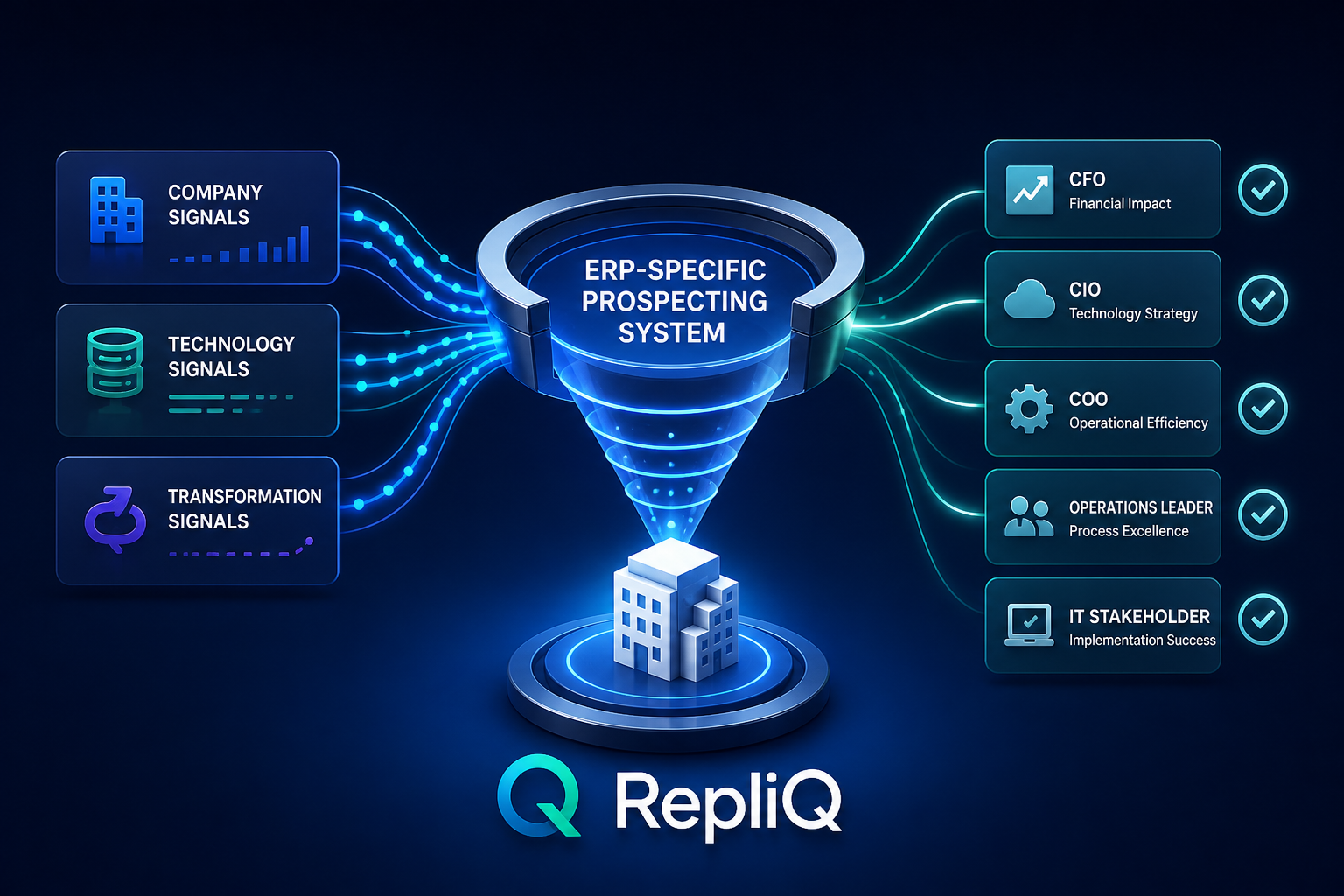
To generate highly qualified ERP consultant leads, consulting firms must look beyond basic contact-level personalization. Effective personalized outreach for ERP consulting companies requires a systematic approach to identifying observable buying signals, building deep account intelligence, mapping complex buying committees, and tailoring outreach to specific implementation realities.
Crucially, this personalization must be rooted in publicly available, observable, or first-party-safe evidence. Relying on fabricated assumptions about a prospect’s confidential systems or internal operational bottlenecks immediately destroys credibility.
This guide provides a practical system for converting public company data, technology ecosystem context, and transformation signals into highly relevant ERP implementation outreach at scale. By leveraging platforms like RepliQ, ERP consulting firms can operationalize this intelligence, transforming raw data into credible, account-based conversations that drive measurable commercial progression.
Identify ERP Implementation and Modernization Buying Signals
The foundation of effective intent-based prospecting for ERP services is identifying accounts that have a credible, verifiable reason to consider an implementation, migration, upgrade, optimization, or integration project.
Segment Accounts by ERP Project Type
Not all ERP implementation sales motions are the same. Each project type carries a distinct value proposition, requires a unique stakeholder map, and demands a specific outreach hypothesis. ERP consultants must segment prospects into clear categories:
- Greenfield ERP implementation: Moving from basic accounting software (like QuickBooks) to a true enterprise system. Prospects here are concerned with scalability, process formalization, and managing the shock of organizational change.
- ERP replacement or modernization: Swapping a legacy on-premise system for a modern solution. These ERP modernization prospects are highly focused on migration risk, data integrity, and minimizing operational disruption.
- Cloud migration: Moving an existing platform to a cloud environment. Key concerns involve security, continuous deployment architectures, and vendor lock-in.
- Platform upgrade: Transitioning to the latest version of a current ERP. Outreach should focus on new feature utilization, integration stability, and avoiding technical debt.
- Post-merger or multi-entity consolidation: Unifying disparate systems after an M&A event. Stakeholders prioritize unified financial reporting, compliance, and workflow standardization.
- ERP optimization and integration: Enhancing an existing system through third-party integrations (e.g., CRM, supply chain tools). The focus is on API architecture, workflow automation, and data visibility.
Build an ERP-Specific Signal Taxonomy
To find active ERP upgrade opportunity signals, consultants must look for observable events that indicate emerging technology needs.
- ERP or technology modernization announcements: Public commitments to digital transformation. As noted in federal technology modernization guidance, modernization and refreshment initiatives are clear indicators of active, funded technology projects. This signals a strategic shift, most relevant to the CIO or CFO. Do not assume the vendor has been selected; validate the timeline.
- ERP-related hiring or leadership changes: Hiring a "Director of Enterprise Applications" or a new CIO. This indicates an impending audit of existing systems. It is highly relevant to the new hire themselves. Do not assume they want to rip and replace immediately.
- Acquisitions, expansion, or new entities: M&A activity creates immediate data consolidation challenges, making it a prime signal for CFOs. Validate if the acquired entity uses a conflicting ERP.
- Integration, data, analytics, or automation initiatives: Job postings for middleware engineers or data architects suggest the current ERP is struggling to communicate with other tools. This appeals to enterprise architects.
- Compliance or reporting pressure: Entering a highly regulated market or preparing for an IPO. This creates strict audit requirements that legacy systems often fail to support.
- Implementation-partner changes: Evidence of a stalled project or dissatisfaction with a current vendor.
- Evidence of a relevant ERP or enterprise software ecosystem: Public case studies, job descriptions requiring specific software experience, or certified partner badges.
A signal is merely a starting point for a relevant hypothesis, not definitive proof that a company is ready to buy. As supported by IT modernization stakeholder and cost-tracking findings, documented decisions and reliable cost signals are critical for determining the true viability of a project.
Create an Account Qualification Scorecard
To prioritize ERP consulting lead generation efforts, implement a lightweight qualification scorecard for every target account. Track the following fields:
- Project type (e.g., Post-merger consolidation)
- ERP or enterprise software ecosystem
- Industry and operating model
- Company complexity (e.g., multi-national, multi-subsidiary)
- Transformation or expansion trigger
- Likely implementation stage
- Integration or data-migration complexity
- Stakeholder evidence
- Signal validation status
Use this scorecard to categorize accounts. High-priority accounts possess multiple corroborating, validated signals. Research-stage accounts have one unvalidated signal requiring further investigation. Low-priority accounts show generic, outdated, or weak indicators.
Crucially, establish a firm rule for enterprise software prospecting: account-based marketing for ERP consultants must pause if a signal cannot be verified or if outreach would require making an unsupported, invasive assumption about the prospect's internal operations.
Build Account and Buying-Group Intelligence
Moving from a static list of companies to a dynamic understanding of business complexity requires synthesizing data into actionable account intelligence.
Combine Firmographic, Technographic, and Transformation Data
Effective ERP sales automation requires combining multiple data layers: firmographic information (size, revenue, industry), technographic evidence (current ERP, CRM, middleware), and transformation signals (hiring, M&A, funding).
Instead of treating these as disconnected data points, synthesize them into a coherent account brief. A standard brief should include:
- What we know: (e.g., "Recently acquired two European subsidiaries; currently hiring NetSuite administrators.")
- What this may indicate: (e.g., "Likely facing multi-currency consolidation challenges and standardizing on NetSuite.")
- What needs validation: (e.g., "Are they migrating the acquired entities to the parent ERP, or running two instances?")
- Who may care: (e.g., "CFO for reporting; CIO for architecture.")
- What useful resource can be offered: (e.g., "A post-merger ERP consolidation checklist.")
Personalization must add decision-useful context. Simply inserting a company name or industry token into a template is insufficient for CRM and ERP integration consulting. Using platforms like RepliQ allows consulting firms to intelligently organize company context, ERP ecosystem data, and implementation signals into usable, scalable account intelligence.
Map the ERP Buying Committee
An ERP project is not an individual purchase; it is an enterprise-wide shift. Therefore, ERP buying committee outreach must treat the opportunity as an account-level buying process. The Baylor University buying-center framework highlights the distinct roles of initiators, gatekeepers, technical influencers, financial influencers, deciders, and champions.
Consider the diverse perspectives within the B2B buying center:
- CFO or finance leader: Focused on the business case, unified reporting, cost control, risk mitigation, and ROI.
- CIO or IT leader: Prioritizes system architecture, data security, integration capabilities, scalability, and implementation governance.
- COO or operations leader: Driven by process efficiency, operational continuity during migration, and user adoption.
- VP Operations or business-unit leader: Cares about workflow consistency, localized visibility, and scalability.
- Enterprise architect or IT program owner: Manages technical dependencies, data migration planning, and execution risk.
- Procurement: Evaluates commercial structures, partner viability, and contract terms.
One validated account insight can and should produce entirely different messages for each of these ERP implementation decision-makers. This account-level strategy is reinforced by Yale research on multi-stakeholder B2B buying, which emphasizes that engaging the broader buying group is critical for complex enterprise sales.
Create a Hypothesis Without Claiming Confidential Knowledge
When crafting a personalized B2B prospecting message, use a simple formulation for your outreach hypothesis:
Observable signal + Possible business implication + Relevant implementation risk or opportunity + Question that invites correction.
For example: "I noticed [Company] recently expanded into the UK market [Observable signal]. Teams in this situation often evaluate how to handle multi-entity financial roll-ups [Business implication] without creating massive manual reconciliation workflows in their ERP [Implementation risk]. Are you currently reviewing your consolidation architecture?"
Use cautious language such as “This may indicate…” or “Firms in this stage often evaluate…” rather than presenting assumptions as absolute facts. This protects your credibility and ensures your ERP consulting marketing strategy remains professional, especially when you lack access to confidential budgets, implementation timelines, or proprietary operational metrics.
Create Role- and Project-Specific Outreach
Translating account intelligence into actual outreach requires matching your message to both the specific ERP project and the individual recipient’s responsibilities.
Match the Message to the ERP Project
ERP implementation sales require a tailored messaging matrix based on the project type:
- ERP Replacement: Primary business concern is operational disruption. Technical concern is legacy data migration. Relevant stakeholder: CIO/COO. Asset: Legacy Migration Risk Checklist. CTA: Review the checklist.
- New Implementation: Primary business concern is process formalization. Technical concern is user adoption. Relevant stakeholder: CFO/COO. Asset: Phase One Readiness Guide. CTA: Compare readiness criteria.
- Migration or Cloud Modernization: Primary business concern is security and uptime. Technical concern is continuous deployment architecture. Relevant stakeholder: CIO. Asset: Cloud Security Architecture Overview. CTA: Discuss migration sequencing.
- Upgrade: Primary business concern is feature utilization. Technical concern is breaking custom integrations. Relevant stakeholder: IT Program Owner. Asset: Version Upgrade Testing Protocol. CTA: Review testing parameters.
- Integration and Optimization: Primary business concern is data silos. Technical concern is API limits and middleware. Relevant stakeholder: Enterprise Architect. Asset: Integration Middleware Comparison. CTA: Discuss API architecture.
- Post-Merger Consolidation: Primary business concern is unified reporting. Technical concern is conflicting data models. Relevant stakeholder: CFO. Asset: M&A Data Harmonization Guide. CTA: Discuss consolidation timelines.
ERP modernization prospects respond to business-relevant hypotheses, not broad, generic overviews of your consulting services.
Tailor the Message to the Recipient
A single company signal—such as an acquisition—must be reframed depending on the recipient.
- To the CFO: Focus on financial visibility, the business case for consolidation, cost control, and minimizing implementation risk.
- To the CIO: Focus on integration architecture, scalability, governance, and minimizing migration dependencies.
- To the COO: Focus on process consistency across the newly acquired entity, operational continuity, and system adoption.
- To the IT Program Owner: Focus on project sequencing, data migration mapping, technical readiness, and delivery risk.
Every outreach attempt must connect a verifiable account signal to a plausible business implication, highlight the consultancy’s relevant expertise, and offer a low-friction next step.
Weak personalization: "Congrats on the acquisition! We provide ERP services for the manufacturing industry. Do you have 15 minutes?"
Strong personalization: "I saw the recent acquisition of [Company B]. Usually, this creates immediate pressure to consolidate financial reporting across conflicting ERP instances. We help manufacturing teams map data migration without disrupting production. Would it be helpful to see our M&A data harmonization checklist?"
Offer Value Before Asking for a Sales Call
Instead of immediately pushing for an ERP consulting discovery call, offer project-specific resources that help the prospect reduce uncertainty. High-value offers include:
- An ERP modernization readiness assessment
- An integration-risk checklist
- An implementation business-case worksheet
- A stakeholder alignment worksheet
- A data-migration planning guide
These assets help prospects structure their own internal conversations. Keep the Call to Action (CTA) specific and low friction—ask if they would like to review a checklist or discuss a confirmed transformation trigger. You can explore how account-specific research supports these diagnostic offers by reviewing RepliQ use cases for ERP implementation lead generation.
Use Multichannel Sequences and Useful Offers
A coordinated outreach motion supports long ERP sales cycles without over-automating or sending repetitive, annoying messages.
Design a Sequence Around Account Progression
An effective sequence for B2B outreach for professional services should map to the account's progression:
- Initial signal-based email: Present the core hypothesis and observable trigger.
- LinkedIn engagement: Connect with context, establishing professional credibility.
- Educational resource: Send a useful, project-specific asset (e.g., a readiness assessment).
- Role-specific follow-up: Reframe the value proposition based on the stakeholder's specific mandate.
- Referral or partner touch: Leverage ecosystem partners or executive-led outreach to build trust.
- Permission-based close: A final clarification asking if the project is a priority for this quarter.
Cadence should be dictated by the strength and freshness of the signal, not an arbitrary volume target. Stop conditions are mandatory. Halt sequences immediately upon a negative response, if a signal is proven outdated, if they already have an implementation partner, if they opt out, or if there is clear evidence the project is inactive. Account coverage and deep relevance always trump repeated, aggressive contact attempts.
Coordinate Email, LinkedIn, Referrals, and Content
Different channels serve different purposes in personalized B2B prospecting. Use email for a concise, evidence-based hypothesis. Use LinkedIn to provide context, showcase thought leadership, and foster professional engagement. Leverage referrals and partner channels to establish trust within complex, high-risk buying environments. Deploy educational content for early-stage research, and reserve executive-led outreach for strategic, high-value accounts.
Align these messages so the prospect experiences a single, coherent account narrative. This stands in stark contrast to general-purpose sales automation that blasts generic templates to maximize contact volume while entirely ignoring the nuanced context of an ERP project. Tools like Scaliq AI can assist in building AI-enabled account intelligence, ensuring personalization and scalable prospecting workflows remain highly coordinated across channels.
Protect Relevance, Accuracy, and Compliance
While AI-assisted research and ERP sales automation are powerful, they must support—not replace—human review. This is especially true for enterprise accounts and when making technical claims. Personalization must be transparent and based on observable evidence. Prohibit teams from fabricating business pain, inventing implementation timelines, or guessing at proprietary technology details.
Furthermore, compliant B2B outreach is non-negotiable. Adhere strictly to commercial email safeguards. As outlined in the FTC commercial email compliance guide, campaigns must include accurate sender information, truthful subject lines, physical address disclosures, clear opt-out mechanisms, and prompt handling of all unsubscribe requests.
The true differentiator for an ERP consultancy is the gap between broad data sequencing tools and a specialized workflow that combines legal signal interpretation, mandatory human review, precise stakeholder mapping, and genuine implementation expertise.
Measure Outreach by Pipeline Progression
Surface-level engagement data—like email open rates—does not reflect the reality of long ERP consulting sales cycles. Metrics must align with actual commercial progression.
Track the ERP Outreach Funnel
Structure your measurement around stages that indicate true momentum in personalized B2B prospecting:
- Signal detected
- Account validated
- Target account prioritized
- Stakeholder identified
- Stakeholder engaged
- Discovery accepted
- Opportunity qualified
- Buying group mapped
- Proposal created
- Sales-cycle progression
- Revenue influenced
Opens, clicks, and replies are merely diagnostic supporting metrics, not the primary definition of success for ERP consulting lead generation. Compare the pipeline velocity of signal-based campaigns against generic outreach using consistent, rigorous qualification criteria.
Define Qualification and Attribution Rules
Document clear rules for account progression. Define exactly what qualifies as a meaningful response, what criteria make a discovery meeting sales-qualified, which specific stakeholders must be engaged before an account becomes an opportunity, and how influenced revenue is recorded across a 12-to-18-month sales cycle.
Account-level measurement prevents a false positive where one junior contact’s engagement is mistaken for actual buying-group progress. As reinforced by IT modernization stakeholder and cost-tracking findings and Yale research on multi-stakeholder B2B buying, organizational progress and documented stakeholder visibility are far more meaningful than isolated individual engagement. Track efficiency (research time saved) alongside quality (qualified meetings, opportunity creation, proposal activity, and revenue influence).
Improve the System Through Controlled Testing
Continuously refine your ERP consulting marketing strategy through controlled testing. Isolate one variable at a time: test different signal types, personas, project-specific offers, CTAs, channel combinations, or outreach timing.
Compare generic messaging against signal-based messaging, keeping account qualification criteria strictly consistent. Treat negative responses and incorrect assumptions not just as campaign failures, but as valuable quality signals to refine your approach. Use these findings to continuously update your account scorecard, messaging matrix, and sequence rules.
Common Mistakes and Safeguards
Advanced ERP sales teams must actively avoid the common failure modes of enterprise software prospecting:
- Treating every signal as buying intent: A new CIO hiring announcement is a trigger for research, not proof of an immediate multi-million dollar ERP budget.
- Contact-level personalization without account context: Using a prospect's first name and college alma mater feels generic and manipulative if the message ignores their company's recent merger.
- Single-threaded messaging: Sending the exact same message to the CFO, CIO, and COO ignores their distinct operational mandates.
- AI hallucinations: Relying on AI-generated claims that cannot be validated by observable, public evidence destroys credibility instantly.
- Excessive automation: Over-automating follow-ups damages trust, particularly in high-risk, high-cost implementation conversations.
- Skipping human review: Always require human oversight for strategic accounts, technical claims, sensitive industries, and complex ERP buying committee outreach. Clear evidence, cautious language, accurate claims, and transparent compliance practices are the bedrock of consultant trustworthiness.
Conclusion
Generating highly qualified ERP consultant leads requires moving away from generic volume and embracing a nuanced, intelligence-driven methodology. The five-part system for success involves:
- Identifying and validating observable ERP implementation or modernization signals.
- Building comprehensive account and buying-group intelligence.
- Tailoring messaging meticulously to both the project type and the specific stakeholder role.
- Deploying coordinated multichannel sequences paired with useful, diagnostic offers.
- Measuring success by account progression, qualified opportunities, and influenced revenue.
Effective ERP outreach is not simply automated personalization. It is the informed interpretation of company complexity, technology context, transformation signals, and stakeholder priorities.
We encourage you to audit your current ERP consulting lead generation efforts against the scorecards and messaging matrices detailed above. To explore how your firm can operationalize this framework, automate account research, and execute compliant, personalized outreach workflows at scale, visit RepliQ.
FAQ
How do ERP consultants generate qualified leads?
Qualified ERP consultant leads are generated by moving away from generic lists and instead selecting accounts based on validated, observable signals—such as modernization announcements, M&A activity, or integration hiring. Success requires comprehensive buying-group coverage, project-specific qualification, and tracking progression toward a validated discovery call or opportunity.
How can ERP consulting firms personalize outbound outreach?
ERP implementation outreach is personalized by combining firmographic company context, public ERP ecosystem evidence, the specific project type, and the stakeholder’s exact role to form a clearly stated outreach hypothesis. Effective personalized B2B prospecting must be useful and evidence-based, extending far beyond superficial first-name or company-name insertion.
Which decision-makers should ERP consultants contact?
ERP buying committee outreach must encompass multiple roles. Consultants should contact CFOs (for financial and ROI concerns), CIOs (for architecture and security), COOs (for operational continuity), enterprise architects, IT program owners, and procurement stakeholders. Each ERP implementation decision-maker requires a distinct message tied directly to their financial, operational, technical, or commercial priorities.
What should an ERP implementation prospecting sequence include?
A successful ERP consulting email campaign sequence includes a validated trigger, a role-specific message, a useful diagnostic offer (like a readiness checklist), coordinated multichannel follow-ups (email and LinkedIn), strict stop conditions, and mandatory human review. It focuses on progressing the account toward a qualified opportunity rather than simply maximizing open or reply rates.
How can ERP consultants measure the ROI of outreach?
Instead of relying on email vanity metrics, ERP sales automation and outreach should be measured by account validation rates, stakeholder engagement, qualified meetings booked, opportunity creation, buying-group coverage, proposal activity, sales-cycle progression, and total revenue influence. This account-level reporting accurately reflects the economics and realities of complex ERP consulting sales.


