.png)
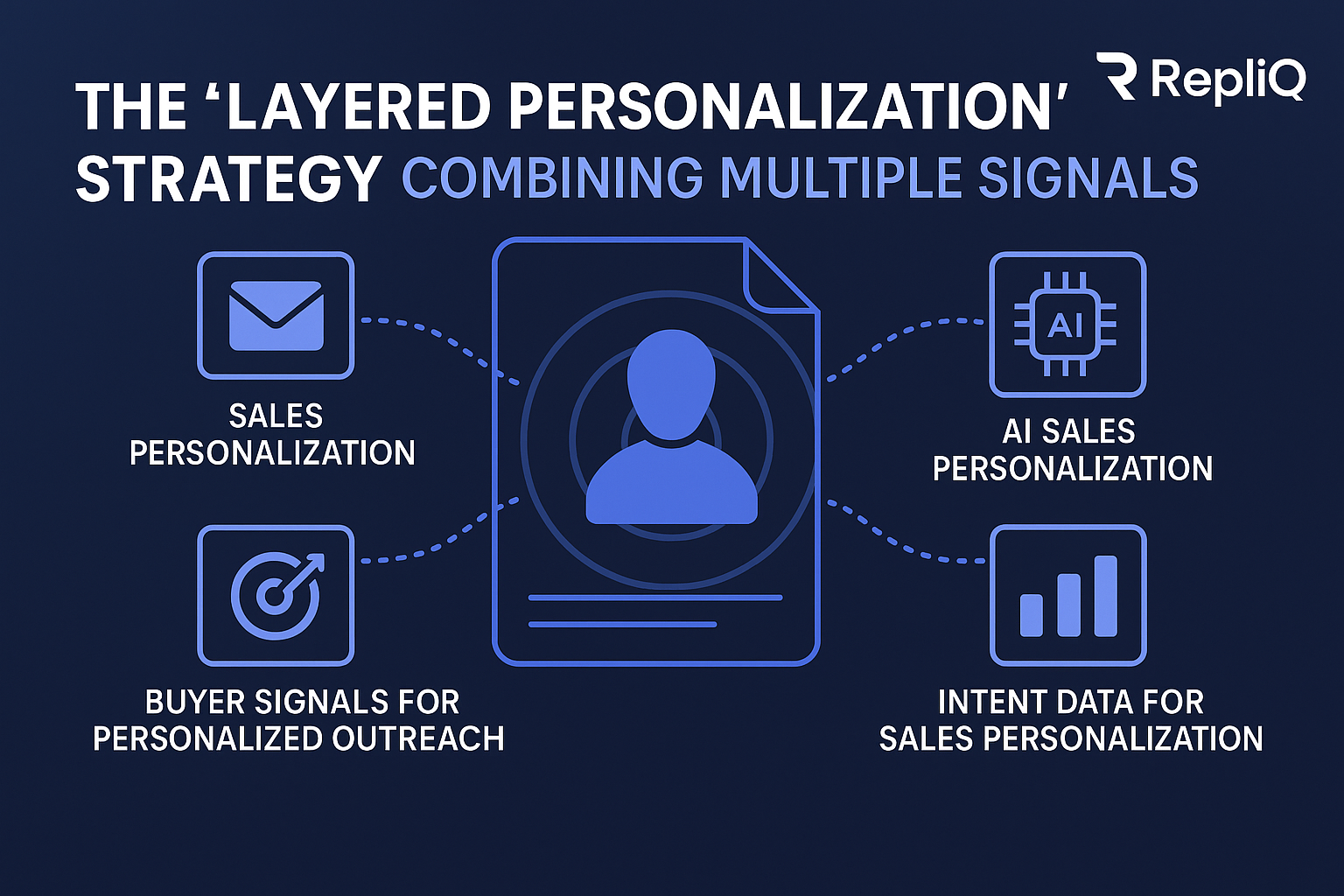
Layered Outreach Personalization: The Most Comprehensive Framework for Multi-Signal Outreach at Scale
For advanced outbound teams, the era of relying on simple merge fields and one-off personalization snippets is over. Dropping a prospect’s first name and company into a templated email no longer creates enough differentiation to consistently lift reply rates or book meetings. The real challenge today isn't a lack of information; sales teams now have access to an overwhelming abundance of firmographic, intent, behavioral, and contextual signals. Instead, the struggle lies in orchestration—deciding exactly which pieces of data actually belong in each touchpoint.
This guide provides a comprehensive framework to solve that problem. By the end of this article, you will know how to prioritize buyer signals, turn them into coherent outreach narratives, and operationalize a multi-signal approach across email, LinkedIn, and personalized video without slowing down execution.
We are skipping the basic “use their first name” advice to focus strictly on advanced sales personalization: orchestration, workflow design, channel logic, and measurement. True personalization is not a standalone feature or a tactical gimmick; it is a signal-orchestration methodology. At RepliQ, our practical experience with workflow-driven personalization and AI-generated visual assets has proven that visual layers only succeed when placed inside a broader, contextually relevant system. Readers looking to explore broader outbound strategy examples can read more on the https://repliq.co/blog after mastering this layered outreach personalization framework.
Table of Contents
- What Layered Outreach Personalization Means
- How to Prioritize Buyer Signals
- Building Layers Across Email, LinkedIn, and Video
- Scaling Personalization with AI and Workflows
- Testing, Attribution, and Avoiding Overpersonalization
- Best Practices and Strategic Takeaways
- Conclusion
- FAQ
What Layered Outreach Personalization Means
Layered outreach personalization is the practice of combining multiple relevant signals into one coherent message architecture, rather than stacking random facts about a prospect into an email. It goes far beyond shallow personalization, basic segmentation, or relying entirely on tool-driven “AI variables.”
To execute dynamic personalization effectively, it is critical to understand the difference between broad segmentation (grouping prospects by industry), targeted messaging (customizing a value proposition for a specific account or persona), and truly tailored outreach (shaping the message around specific timing, context, and behavior). According to foundational research on tailored vs. targeted communication, tailored messaging uniquely addresses the individual context of the recipient, significantly outperforming mass or merely targeted communication.
This framework relies on three core layer types:
- Account-level signals: Data about the company.
- Persona-level signals: Data about the individual's role and challenges.
- Trigger-based signals: Data about timely events or actions.
While more data is available today than ever before, relevance depends entirely on orchestration and judgment, not data quantity. Unlike enrichment-first tools that treat one layer of data as a complete strategy, a true multi-signal approach focuses on the methodology of blending these inputs seamlessly.
Why Single-Signal Personalization Breaks Down
Outreach based on a single data point—such as an industry classification, a recent funding event, or a job title—often feels generic because it lacks narrative depth. While single-signal personalization can be a useful starting point for segmentation, it falls short as a complete message strategy.
When you contrast shallow personalization with a layered message, the difference in quality is obvious. A layered message combines company context, persona relevance, and a timely trigger to create a compelling reason to engage.
Bad Example (Single-Signal):
"Hi [Name], I saw [Company] recently raised a Series B. We help growing companies scale their sales teams. Want to chat?"
Better Example (Layered):
"Hi [Name], I saw [Company]’s recent Series B is earmarked for expanding your EMEA footprint (Trigger). Typically, VP of Sales (Persona) expanding into new regions struggle to keep ramp times under 60 days (Account/Persona Pain). We help..."
The layered approach uses buyer signals to build a personalized outreach example that proves you understand their specific business reality.
The 3-Layer Model: Account, Persona, Trigger
To build a compelling narrative, you must synthesize three distinct layers of data:
- Account-level signals: These include firmographic data, technographic stacks, category maturity, market positioning, and historical hiring patterns. This layer establishes that your solution fits their business model.
- Persona-level signals: These cover role priorities, function-specific pain points, likely KPIs, and organizational structure. This layer proves you understand the day-to-day reality of the person you are emailing.
- Trigger-level signals: These encompass behavioral signals like website activity, content engagement, recent hiring pushes, product launches, social activity, intent spikes, and recent press announcements. This layer answers the question: "Why now?"
Stronger outreach always begins with deep account and persona relevance, which is then sharpened and mobilized by trigger timing.
What Makes a Personalization Layer “Strong”
Not all data points are created equal. To avoid overpersonalization in outreach, evaluate every potential signal against these five criteria:
- Reliability: Is the data source accurate and trustworthy?
- Freshness: Did this event happen recently enough to matter?
- Relevance: Does this signal connect directly to your offer or their pain point?
- Ease of Verification: Can you confirm this is true without making assumptions?
- Fit for the Channel: Is this information appropriate for an email, a LinkedIn message, or a video?
Remember, adding more layers does not automatically yield better results. A multi-signal approach relies on reliable data sources for personalization to craft a concise, impactful message.
How to Prioritize Buyer Signals
Sales teams often have access to an overwhelming number of buyer signals but lack a clear hierarchy for deciding which to use first. Without a prioritization model, reps waste time sifting through intent data and risk sending disjointed messages.
To preserve authenticity and maintain campaign throughput, signals must be organized into tiers based on reliability, effort required, likely impact, timing, and channel fit. Just as CDC guidance on understanding your audience emphasizes that audience understanding should dictate message relevance and channel adaptation, your outreach must be adapted to the signals you trust most. Furthermore, adhering to OECD privacy principles ensures you respect boundaries around what data should and should not be used in B2B communications.
Tier 1 Signals: High-Confidence, High-Relevance Inputs
Tier 1 signals are the foundation of ABM personalization and should take priority in first-touch outreach. They include:
- Firmographic fit (revenue, employee headcount, industry)
- Role relevance (verified job title and responsibilities)
- Verified business context (technographics, public company initiatives)
- Owned engagement data (previous inbound inquiries, webinar attendance)
- Obvious trigger events tied directly to pain or opportunity (a new executive hire in the target department)
Because these signals are verified and highly relevant, they are far less risky than inferred intent data. For example, referencing that a company just acquired a competitor (Tier 1) creates a natural opener about integration challenges without sounding invasive.
Tier 2 Signals: Intent and Behavioral Context
Tier 2 signals encompass third-party intent data and behavioral signals. These become powerful when used to sharpen the timing or angle of a message, but they must be handled with care.
Not all intent signals are equally useful; you must assess their freshness and directness. Website visits, content consumption, job changes, or social activity should influence your messaging, but you should never overstate what you "know." Instead of saying, "I saw you downloading our whitepaper," use the behavioral signal to trigger a timely, relevant outreach: "Given the recent shifts in [Industry Topic from Whitepaper], I thought you might be evaluating..." This is the essence of trigger-based outreach.
Tier 3 Signals: Interesting but Low-Value Facts
Trivia-based personalization almost always fails. Tier 3 signals include generic company awards, minor press mentions, or surface-level LinkedIn observations (e.g., "I see you went to the University of Michigan"). These facts rarely connect to business relevance.
There is a massive difference between a detail being “noticed” and being “useful.” If a signal does not change the angle of your sales personalization or directly tie to your value proposition, do not lead with it. Relying on prospect research automation to scrape irrelevant trivia is a fast track to being ignored.
A Practical Signal Scoring Framework
To execute a multi-signal approach effectively, adopt a simple scoring model to evaluate buyer signals before combining them for outreach personalization:
| Criteria | Question to Ask | High Score Example | Low Score Example |
|---|---|---|---|
| Reliability | Is the data verified? | Direct CRM engagement data | Unverified 3rd-party intent surge |
| Freshness | Is it current enough to act on? | Executive hired this week | Funding round from 14 months ago |
| Relevance | Does it connect to the pain point? | Job posting lists missing software | Generic "Top 50 Workplaces" award |
| Actionability | Does it change what you say? | Shaping the pitch around a new product | Mentioning the weather in their city |
| Channel Fit | Does it fit the medium? | Professional context for LinkedIn | Referencing personal hobbies |
Unlike tool-centric approaches that simply push you to collect more data, this framework ensures you filter and apply only the data that drives revenue.
Building Layers Across Email, LinkedIn, and Video
Layered personalization is not about copy-pasting the exact same insight into every channel. It is about adapting the same underlying account narrative into different formats. Multichannel outreach requires understanding that email, LinkedIn, and personalized video outreach each support different depths, tones, and call-to-action patterns.
Let’s follow a running example: targeting a VP of Engineering at a mid-market SaaS company that just announced a shift toward enterprise clients.
Email: Lead with Relevance, Not Data Density
Email should leverage your strongest 1–2 signals to create immediate relevance without overwhelming the reader with data density. The best intent-based cold email feels informed, not exhaustively researched.
An ideal email structure follows this flow:
- Relevant opener: Acknowledge the account/trigger signal.
- Role-specific problem framing: Connect the trigger to a persona-level pain point.
- Proof/insight: Provide value or a brief case study.
- Clear CTA: Ask for interest, not just time.
Example Email: "Hi [Name], noticed the recent push upmarket to enterprise clients. Usually, VPs of Engineering face massive compliance bottlenecks when adapting legacy architecture for enterprise SLAs. We helped [Competitor] cut compliance review times by 40%..." This cold email personalization blends an account trigger with persona relevance seamlessly, protecting email deliverability by avoiding spammy, variable-stuffed templates.
LinkedIn: Use Context to Continue the Story
LinkedIn personalization works best as contextual reinforcement rather than a hard sales pitch. Reps can reference the same account and persona logic used in their emails, but the tone must be adjusted to fit a social platform.
Effective LinkedIn message types include:
- Connection request with light relevance: "Following your team's move upmarket—great milestone."
- Follow-up referencing market context: "Sent an email earlier regarding the enterprise architecture shift. Curious how you're handling the compliance load?"
- Comment/engagement: Engaging with a visible trigger on their feed.
Always avoid using private-feeling, inferred behavioral buyer signals in public or semi-public channels. Keep behavioral trigger outreach professional.
Personalized Video: Add Human Context to High-Value Accounts
Visual personalization deserves inclusion in your outreach when dealing with high-value accounts, competitive deals, awareness-stage outreach where differentiation is critical, or follow-ups that benefit from richer context.
Personalized video outreach should synthesize your layered research into a compelling narrative, not just read the email script word-for-word. A rep might use an account context, a persona pain point, and a timely trigger to create a short, highly credible 45-second video. For teams looking to scale this, incorporating https://repliq.co/ai-images can drastically increase attention rates. At RepliQ, we’ve found that AI-generated visual assets and personalized videos work best when grounded in deep buyer context, ensuring they serve as a powerful narrative tool rather than a mere novelty. This is the peak of ABM personalization.
Optional Layer: Personalized Landing Pages or Microsites
For larger ACV outbound motions, ABM campaigns, and multi-stakeholder buying groups, dynamic pages can continue the narrative from your outreach and reinforce account-specific relevance.
When utilizing dynamic personalization on a microsite, customize the following elements:
- Headline: Address the company and their specific goal.
- Use case: Highlight the solution most relevant to their trigger event.
- Proof points: Show case studies from their exact industry.
- Relevant creative: Use personalized visual assets that mirror the outreach.
A Sample Multi-Channel Layering Sequence
Here is how you orchestrate layered outreach personalization across a multi-channel sequence:
- Day 1 (Email): Lead with an account + persona signal to frame the core problem.
- Day 3 (LinkedIn): Send a connection request offering contextual reinforcement (light touch).
- Day 5 (Video): Send a personalized video via email using account + persona + trigger data to visually explain the solution.
- Day 7 (Email Follow-up): Reference their engagement (or non-engagement) path, offering a high-value asset related to the initial trigger.
This trigger-based outreach ensures the message evolves naturally without repeating the exact same personalization angle.
Scaling Personalization with AI and Workflows
Operationalizing this framework is where advanced teams pull ahead. Scaling personalization requires robust systems for collecting, summarizing, validating, and activating signals without creating manual research bottlenecks.
AI should support reps by distilling scattered data into usable inputs, not by inventing unsupported personalization. By structuring prospect research automation into distinct workflow stages—data collection, enrichment, summarization, message generation, human review, and activation—teams can maintain quality at scale. Aligning these systems with the NIST AI Risk Management Framework ensures governance, reliability, and responsible AI use. RepliQ’s workflow-driven personalization architecture serves as practical evidence that connecting research inputs to creative output layers is the key to scalable success. For deeper insights into advanced automation strategy, explore the https://repliq.co/blog.
The Workflow Architecture Behind Layered Personalization
To understand how AI improves multi-signal personalization at scale, look at how inputs move through a modern workflow:
- CRM Data & Enrichment Sources: Foundational Tier 1 firmographic and demographic data is pulled.
- First-Party & Intent Inputs: Behavioral signals and website intent are layered in.
- Summarization: AI processes the raw data, highlighting the most relevant buyer signals.
- Channel-Specific Content Blocks: The system routes the insights into appropriate email, LinkedIn, or video templates.
Orchestration matters far more than any single data source. An AI workflow automation system ensures the right signal reaches the right channel at the right time.
Where AI Adds Real Leverage
AI personalization offers massive leverage when used correctly. The best use cases include:
- Summarizing extensive account research into bullet points.
- Identifying the strongest message angles based on the scoring framework.
- Matching signals to specific channel templates.
- Generating draft scripts for personalized video outreach.
- Personalizing creative and visual assets dynamically.
However, AI should never be trusted blindly. AI cannot be allowed to make unsupported claims, fabricate insights, or rely on stale, unverified trigger statements. The safest and most effective model for dynamic personalization is "AI-assisted, human-reviewed."
Human Review Checkpoints That Preserve Authenticity
To maintain trust and high reply quality, human review must remain part of the workflow. Review checkpoints should focus on:
- High-value, Tier 1 account messaging.
- Unusual or highly specific trigger claims.
- Sensitive, inferred, or privacy-adjacent references.
- The relevance of the final Call to Action (CTA).
A practical rule of thumb for sales personalization: If a claim would feel awkward to defend if challenged by the prospect on a live call, verify it before sending. Human review is not friction; it is essential quality control to avoid overpersonalization in outreach.
Governance, Privacy, and Data-Use Boundaries
Advanced teams must use buyer data responsibly. There is a fine line between useful context and invasive specificity. Relying on inferred data to demonstrate how closely you are tracking a prospect implies surveillance and destroys trust.
Always prioritize first-party data and clearly relevant, publicly available business signals. Strict adherence to FTC consumer privacy guidance and OECD privacy principles is non-negotiable. While many automation guides focus purely on the mechanics of scale, true professionals understand that governance, trust, and authenticity safeguards are what actually protect your brand's reputation and deliverability.
Testing, Attribution, and Avoiding Overpersonalization
Moving from theory to performance management requires rigorously testing your personalization layers. Advanced outbound teams do not ask, "Does personalization work?" Instead, they ask, "Which layer improves which outcome, in which channel, for which segment?"
You must measure the incremental value of each personalization layer while balancing the need for deep relevance against the realities of campaign throughput.
How to Design Layer-Based Tests
To understand how to scale cold email personalization effectively, design structured, incremental experiments:
- Control: Segmentation only (Industry + Persona).
- Variant A: Account + Persona layer.
- Variant B: Account + Persona + Trigger layer.
- Variant C: Layered message + Visual asset (AI personalization).
Analyze the metrics that matter at each stage. Interpret open rates carefully, but focus heavily on reply rates, positive reply rates, meeting-booking rates, and click-through/watch rates for visual layers in multichannel outreach. Always test one additional layer at a time to isolate the variable causing the lift.
What Good Attribution Looks Like in Multi-Channel Outreach
Attribution gets messy when a prospect reads an email, ignores it, sees a LinkedIn touch, watches a personalized video, and finally replies to a follow-up email. Perfect attribution is unrealistic.
Instead, rely on practical approaches:
- Campaign-level attribution: Measuring the overall lift of a layered ABM personalization campaign.
- Touch-sequence analysis: Identifying which step in the sequence generates the most positive replies.
- Account-level engagement mapping: Tracking overall account warmth based on behavioral signals.
- Message-angle tagging: Tagging which trigger signals yield the best meetings.
Directional learning is enough to continuously improve your sequencing.
The Warning Signs of Overpersonalization
Bad personalization reduces trust faster than generic outreach. Watch for these red flags to avoid overpersonalization in outreach:
- Too many facts: Cramming 4-5 different data points into one cold email personalization opener.
- Weak triggers: Referencing a blog post from three years ago.
- Invasive references: Mentioning inferred private data or personal social media activity.
- Disconnected data: Personalizing the intro, but failing to connect it to the value proposition.
- Robotic phrasing: Visibly automated variables that break the natural flow of a sentence.
Do: Use buyer signals to frame a business problem.
Don't: List facts just to prove you did research.
A Practical Optimization Loop for Advanced Teams
Build a continuous feedback loop between your outreach execution and your prospect research automation strategy:
- Collect response data: Aggregate positive and negative replies.
- Review winning signals: Identify which data layers consistently appear in positive replies.
- Refine scoring rules: Adjust your AI personalization prompts and signal scoring framework.
- Update templates: Refine how layers are expressed by channel.
- Adjust visual effort: Determine exactly which segments warrant the effort of personalized visual assets.
Document your "winning layer combinations" by segment and persona to ensure the whole team benefits from layered outreach personalization.
Best Practices and Strategic Takeaways
This framework provides repeatable principles that can be applied to any outbound motion. Mastering sales personalization requires discipline, strict data governance, and continuous iteration across your multichannel outreach.
The 7 Rules of Strong Layered Personalization
- Use only signals that change the message: If the data doesn't alter your angle, leave it out.
- Prioritize freshness and relevance over novelty: A recent hiring push is infinitely more valuable than a generic company award.
- Match personalization depth to channel and account value: Save highly produced dynamic personalization for Tier 1 accounts.
- Let triggers shape timing, not just copy: Use behavioral signals to dictate when you reach out.
- Pair text personalization with visual personalization selectively: Use visual layers to break through the noise on high-value deals.
- Automate research, not authenticity: Use AI to gather and summarize data, but keep humans in the loop for final review.
- Measure each added layer for incremental lift: Continuously test to find the optimal multi-signal approach.
Conclusion
Layered outreach personalization consistently outperforms shallow tactics because it transforms multiple, disparate buyer signals into a coherent, channel-aware narrative. By shifting away from single-variable gimmicks, you prove to prospects that you understand their specific business context, their role, and the urgency of their current situation.
To execute this framework, you must define your data layers, score your signals rigorously, adapt your message for the appropriate channel, operationalize the heavy lifting with AI workflows, test your results incrementally, and constantly guard against overpersonalization.
As more sales teams gain access to raw enrichment data and AI personalization tools, raw data volume will cease to be an advantage. Signal judgment and orchestration will become the ultimate differentiators. Advanced outbound teams must evaluate where visual personalization, AI summarization, and workflow automation fit inside their broader outreach systems to stay competitive. We invite teams evaluating visual personalization layers to explore how https://repliq.co/ai-images fit into a broader multi-signal outreach strategy, leveraging RepliQ's practical experience in enabling scalable, workflow-driven personalized assets.
FAQ
What is layered personalization in outreach?
Layered outreach personalization is the methodology of combining multiple relevant buyer signals—specifically account, persona, and trigger data—into a single, coherent message. Instead of relying on one shallow personalization token, the goal is to build deep relevance and a compelling narrative, prioritizing message quality over mere data quantity.
Which signals matter most for B2B personalized outreach?
The highest-value buyer signals are those with strong business relevance and high confidence. These include Tier 1 firmographic vs intent data, such as firmographic fit, verified role relevance, first-party engagement data, and timely trigger events (like executive hires or funding rounds tied to specific initiatives). Weak or stale third-party signals should be treated with extreme caution.
How do you combine multiple signals without sounding creepy?
To avoid overpersonalization in outreach, only use behavioral signals that help explain your business relevance. Avoid referencing data that implies hidden surveillance or excessive monitoring of a prospect's personal activity. Use sales personalization signals to shape the business narrative rather than listing every detail you discovered during your research.
How can AI improve multi-signal personalization at scale?
AI personalization excels at prospect research automation, specifically in summarizing vast amounts of account data, generating relevant message angles, drafting content, and adapting messages for different channels. However, to ensure authenticity and accuracy, AI must always be paired with strict verification and human review workflows.
How do you measure the value of each personalization layer?
To accurately measure the incremental value of each personalization layer, use structured A/B testing in your multichannel outreach. Add one signal layer or one channel layer at a time (e.g., comparing a text-only layered email to a layered email with a personalized video). Compare outcomes like reply rates, positive reply rates, and meeting-booking rates. Remember that while attribution in testing personalization does not need to be perfect, directional data is highly useful for optimization.

.svg)
.png)


.svg)