
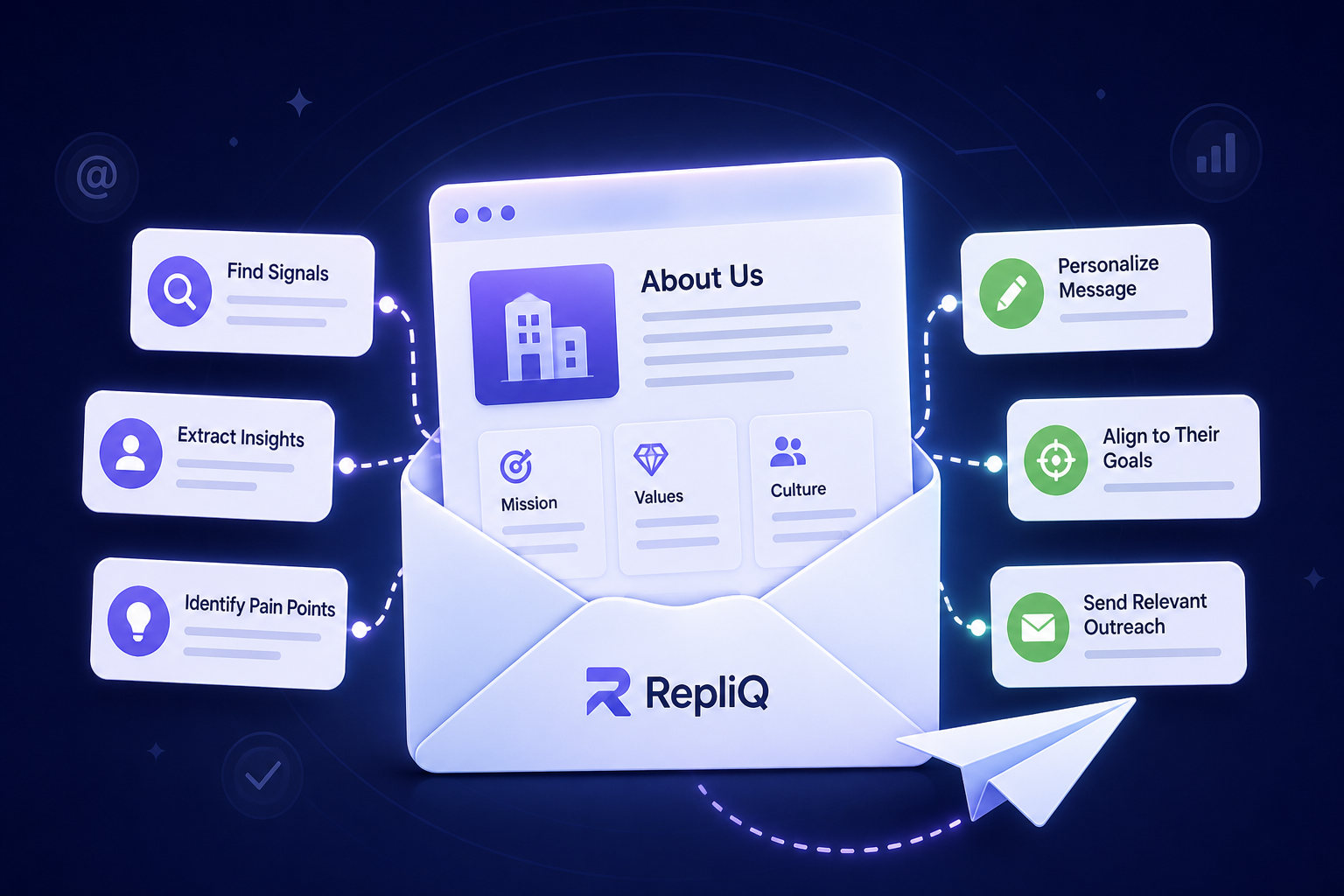
How to Personalize Outreach Using a Company’s About Page
Sales professionals face a persistent dilemma when conducting company research for sales: they know cold outreach personalization is essential for breaking through the noise, but they often default to sending generic compliments or waste hours over-researching a single account. “I loved reading your website” is no longer enough to earn a buyer’s attention. However, there is an often-overlooked asset sitting in plain sight that can provide highly relevant business context: a company’s About page.
An About page is not just a repository for background information; it is a strategic document. When utilized correctly, about page personalization allows you to anchor your outreach in a company’s positioning, history, mission, and customer focus. At RepliQ, we recognize that these elements create highly relevant, business-level personalization that bridges the gap between what a company values and what you offer. According to Stanford research on email personalization, including recipient-relevant information can significantly improve the effectiveness of your outreach by making the message feel tailored and specific, rather than purely promotional.
This article will show beginners how to systematically scan an About page, identify meaningful signals, connect them to a prospect’s role, and distill that research into a concise, natural outreach line. You will learn the critical difference between an interesting company fact and a highly useful sales insight. By following a structured workflow—scan, select, interpret, validate, write, and review—you can execute effective personalization at scale.
What an About Page Can Reveal About a Company
To master about us page research, you must first understand the difference between a basic company description and actionable business context. A basic description tells you what a company sells; actionable context tells you how they view their market and why they operate the way they do. B2B prospect research should focus heavily on the latter.
When executing company-level personalization, an About page can reveal vital signals about a business, including:
- Company origin and founding story: Why the company was built and the original problem it set out to solve.
- Mission and long-term purpose: The ultimate goal the business is driving toward.
- Positioning and differentiation: How the company separates itself from competitors in a crowded market.
- Target customers or markets: The specific audience the company is built to serve.
- Customer promises and operating principles: The core values that dictate how the team operates internally and externally.
- Growth milestones, product changes, or strategic evolution: Timelines, acquisitions, or shifts in service offerings.
It is crucial to remember that these details are clues, not absolute proof of a current pain point or buying intent. A statement about "rapid growth" is a fact stated on the page; assuming their HR department is overwhelmed is a cautious interpretation you must validate. Furthermore, company-level research should always complement—never replace—research about the individual prospect’s specific role and daily responsibilities. By analyzing the overlooked strategic layer of an About page before drafting your message, you ground your outreach in reality rather than relying on complex enrichment tools or superficial visual tricks.
The Difference Between an Interesting Fact and a Useful Sales Signal
Not all information is created equal in sales prospecting research. An interesting fact is a detail that is memorable but does not support a logical, relevant reason for contacting the prospect. For example, knowing that a company’s founders met in a coffee shop in Seattle is interesting, but it does not help you sell cybersecurity software.
A useful signal, on the other hand, is a verifiable company detail that can be directly connected to a likely priority, responsibility, or business outcome.
When evaluating company research for sales, you must distinguish between weak and strong signals. A weak signal is generic marketing copy, such as a company stating, "We are customer-focused." A stronger signal is a clearly stated customer segment, a recent repositioning to enterprise clients, or a specific operational focus. Never treat aspirational mission statements or enthusiastic growth language as definitive evidence that a company desperately needs your specific solution. Use them to craft relevant outreach messaging that asks the right questions.
A Five-Step About Page Personalization Workflow
To make personalized sales outreach practical for routine prospecting, you need a repeatable process. Without a system, you risk falling down a research rabbit hole. This five-step workflow empowers beginners to turn website research into a natural, highly relevant outreach opener.
- Scan the About page for high-value signals.
- Extract specific evidence from the text.
- Interpret the possible business relevance of that evidence.
- Validate it against the recipient’s role and your offer.
- Write one concise observation and a clear reason for reaching out.
To maintain sales outreach personalization at scale, always use a fixed research time limit—such as three to five minutes per account. Keep a basic B2B company research checklist to record the source wording, the page URL, the date you reviewed it, the possible implication, and your final outreach angle. For more insights on building robust outreach systems, explore our broader resources at INTERNAL_LINK: https://repliq.co/blog.
Step 1 — Scan the Page for High-Value Signals
When conducting About Us page sales prospecting, do not try to read and copy every single detail. You only need one or two facts that can support a relevant message. Prioritize the company’s origin story, mission, company positioning, target customers, differentiators, leadership language, proof points, and any signs of recent change.
Use headings, bolded statements, timelines, customer descriptions, and repeated strategic phrasing as your scanning cues. To quickly find what matters, use this mini-checklist:
- What does the company say it exists to do?
- Who does it specifically serve?
- What does it claim to do differently than others?
- What has recently changed or grown?
- What primary business outcome does it emphasize for its clients?
By answering these questions, you can avoid quoting a generic company mission statement in sales emails and instead pinpoint strategic context.
Step 2 — Turn a Company Fact Into a Possible Business Implication
Once you have your evidence, you must translate it into a relevant business implication. This is the core of effective company-level personalization.
Consider this transformation:
- Evidence: “The company expanded from serving one local market to serving several international regions.”
- Possible implication: The operations or revenue team may be managing a broader, more complex go-to-market challenge.
- Outreach angle: Ask whether standardizing their international onboarding workflow is a current priority.
When crafting personalized cold emails, your implications must remain cautious. Use softening language such as “I noticed,” “it looks like,” or “I was curious whether.” Never assume that a growth milestone automatically means the company is struggling or failing.
Use this simple signal-to-relevance framework to guide your relevant outreach messaging:
- Company fact: What the page explicitly says.
- Likely business context: What that fact means for their daily operations.
- Recipient responsibility: Who is in charge of that operation.
- Relevant outcome: The result your product delivers.
- Reason for contacting them: Connecting their context to your outcome.
Step 3 — Validate the Insight Against the Prospect and Offer
A brilliant piece of company research for sales will still feel entirely irrelevant if it is not connected to the recipient’s specific role. If you pitch an HR solution using a company fact about their new software feature, the HR director will be confused.
Before writing your personalized sales outreach, ask yourself:
- Would this fact actually matter to this specific prospect’s function?
- Does the company fact logically relate to the problem my offer addresses?
- Is my implication supported by the available evidence?
- Can this message be understood immediately without a long, convoluted explanation?
Check the recipient’s current responsibilities or publicly available professional context (like a LinkedIn headline) to validate your angle, but avoid over-researching. Remember the distinct difference in prospect research: company-level personalization explains why this business is a good fit, while individual-level personalization explains why this person is the right recipient.
Step 4 — Write the Observation and Reason for Contact
When drafting personalized cold email opening lines, simplicity wins. Use a straightforward structure for your first two sentences:
- Observation: Mention one specific, verifiable company detail.
- Connection: Explain why it relates to the recipient’s role or your reason for contacting them.
Keep the cold outreach personalization concise. Do not summarize their entire About page back to them—they already know what their company does. Use natural language that adds your own interpretation rather than awkwardly copy-pasting the company’s exact marketing jargon. Finally, ensure your call to action follows logically from the observation and your offer. To see exactly how to format these validated insights into high-converting copy, check out our guide on creating INTERNAL_LINK: https://repliq.co/personalized-lines.
About Page Signals and the Outreach Angles They Can Support
The same company fact can support entirely different personalized sales outreach angles depending on the prospect’s role and what you are selling. A software expansion means one thing to a CTO and something entirely different to a VP of Marketing. Select just one angle per email rather than trying to cram every available signal into a single message.
Mission and Customer Focus
A mission statement reveals the customers, outcomes, or problems the company prioritizes. However, citing a company mission statement in sales emails requires finesse.
Move beyond merely repeating the mission.
- Weak: “I love your mission to help businesses grow.”
- Stronger direction: Connect their stated customer focus to a relevant workflow. “I saw your mission is to simplify logistics for independent retailers. I’m reaching out because...”
Use mission language only when it directly helps explain why your outreach is relevant. The guardrail here is critical: do not imply that a stated mission proves the company currently has a specific, debilitating operational problem. Keep your relevant outreach messaging focused on alignment.
Origin Story and Company History
A founding story provides clues about the company’s original problem, their market expertise, or their unique point of differentiation. When utilizing company history personalization, use the context to create a thoughtful observation rather than offering generic praise.
Clarify in your own mind that while company history suggests strategic context, it does not necessarily indicate their current quarterly priorities. Therefore, during about us page research, only connect the origin story to the recipient’s responsibility when the connection is highly credible and logically sound for B2B prospect research.
Positioning, Differentiators, and Target Customers
Positioning language reveals the company’s market, ideal buyer, competitive focus, and customer promise. This information is invaluable for tailoring the vocabulary and business outcomes in your personalized cold emails.
If their company positioning heavily emphasizes "enterprise-grade security," you know to frame your offer around risk mitigation and compliance rather than just "saving time." However, avoid claims that the company is “the best,” “fast-growing,” or “unique” unless the page explicitly supports and quantifies those claims. Distinguish meaningful differentiation in your B2B company research from generic website filler words like “innovative” or “trusted.”
Growth, Change, and Strategic Signals
Expansion into a new market, a broader customer base, or a changed product description are excellent strategic signals. Treat these as timing clues for your sales prospecting research—they are indicators of momentum, not definitive evidence of intent or need.
When referencing company growth signals, use language that invites confirmation instead of making a strong, arrogant assumption. Always cross-check dates and current wording on the website before referencing a change to ensure your sales outreach personalization at scale remains accurate and timely.
Before-and-After Examples of About Page Personalization
To master relevant outreach messaging, you must see the full transformation from raw source evidence to a polished email line. The following fictional examples demonstrate how to apply these concepts practically, moving away from abstract advice and toward concrete personalized outreach examples.
Example 1 — A Mission-Led Company
- Source fact: Acme Logistics’ About page states: "Our mission is to guarantee next-day delivery for independent e-commerce brands."
- Weak interpretation: "I saw your mission is to guarantee next-day delivery. That’s awesome! We sell route optimization software."
- Improved interpretation: Acme is prioritizing delivery speed for a specific niche; the VP of Operations is likely measured on delivery SLA compliance.
- Final outreach line: "I noticed Acme’s mission focuses heavily on guaranteeing next-day delivery for independent brands. I’m reaching out because we help logistics teams maintain 99% SLA compliance during peak volume seasons. Is route efficiency a priority for your team right now?"
- Why the line is more relevant: This mission-based personalization connects the stated customer outcome to the recipient’s likely responsibility. It remains cautious, doesn't claim to know their internal problems, and features a short CTA directly related to the proposed business outcome of the personalized cold emails.
Example 2 — A Company With a Distinctive Customer Segment
- Source fact: Nimbus Software’s About page states: "Built exclusively for mid-sized dental practices."
- Weak interpretation: "I see you work in the dental software industry."
- Improved interpretation: Nimbus has a highly specific target audience. The Head of Marketing needs campaigns tailored to dental practice owners, not generic B2B buyers.
- Final outreach line: "I saw on your About page that Nimbus is built exclusively for mid-sized dental practices. Since reaching practice owners requires a highly specific marketing approach, I was curious if you are currently looking to improve ad conversion rates within the healthcare niche?"
- Why the line is more relevant: This target customer personalization makes the message vastly more relevant than a generic industry reference. It demonstrates company-level personalization first, followed immediately by role-level prospect research.
Example 3 — A Company Showing Signs of Change
- Source fact: Apex Financial’s timeline shows: "2023: Expanded our advisory services to include European markets."
- Weak interpretation: "Congrats on expanding to Europe! You must be struggling with compliance."
- Improved interpretation: European expansion introduces new regulatory and onboarding complexities for the Director of Compliance.
- Final outreach line: "I noticed Apex recently expanded its advisory services into European markets. Often, geographical expansion brings new localized compliance challenges. Are you currently exploring ways to automate your EU regulatory reporting?"
- Why the line is more relevant: This uses company growth signals responsibly. The personalized sales outreach verifies the change but avoids presenting growth as proof of a problem. The question-based CTA tests whether the inferred priority is actually relevant to their cold outreach personalization strategy.
Quality Control: How to Stay Specific Without Sounding Forced
The fastest way to damage your credibility is through poorly executed personalization. To ensure your cold email personalization is effective, implement a strict final review before sending.
Ask yourself:
- Is the fact accurate and current?
- Is it specific to this company, or could it apply to their competitors?
- Does it seamlessly connect to the recipient’s role?
- Does it logically support the reason for contacting them?
- Does it sound natural when read aloud?
In personalized outreach best practices, one meaningful, accurate sales personalization insight is always stronger than listing several shallow details just to prove you visited their website.
Common Mistakes and Better Alternatives
Beginners often fall into predictable traps that result in generic outreach. Here is how to correct them:
- Repeating the About page word for word: Instead, add a relevant interpretation that shows you understand what the words mean for their business.
- Using praise without a business connection: "Great website" means nothing. Instead, explain why the detail matters to the recipient’s workflow.
- Making assumptions from one sentence: Instead of diagnosing their business, use cautious, confirmatory language.
- Overloading the email with research: Keep only the single strongest signal.
- Using outdated company information: Always verify the page and relevant dates.
- Personalizing for the company but not the recipient: Always connect the company observation to the prospect’s specific role and responsibility.
This practical, human-verified workflow stands in stark contrast to poorly executed AI-assisted personalization that merely scrapes and inserts shallow or unverified fields into templates. True personalized sales outreach requires critical thinking.
What to Do When the About Page Has Little Useful Information
Sometimes, an About page is just a sparse paragraph. When this happens, use only what is clearly verifiable rather than inventing a narrative. Treat the About page as just one input for your B2B prospect research, and combine it with relevant role, product, hiring, or company-change information from other sources.
If there is no strong company signal, a short, highly relevant role-based message is always better than forced, awkward company research for sales. Rely on a transparent, useful reason for contacting the prospect instead of manufacturing a fake compliment to force relevant outreach messaging.
Ethical and Compliance Considerations
Publicly accessible company information must still be utilized carefully and respectfully. When crafting outreach, absolutely avoid sensitive personal details, intrusive references, deceptive claims, and unsupported assumptions.
Always adhere to practical commercial-email safeguards. This includes providing accurate sender information, writing non-deceptive subject lines, including a valid physical address where required, and offering a clear, frictionless opt-out process. Privacy and direct-marketing requirements vary heavily by audience location and applicable law.
For U.S. commercial-email requirements, ensure you review the FTC CAN-SPAM compliance guide. For lawful data use, transparency, handling objections, and privacy-conscious personalization in the UK and Europe, consult the ICO direct marketing guidance. Finally, be aware that excessive or unclear personalization can backfire; Research on overly personalized email supports the point that when outreach feels overly intrusive, it triggers reactance and damages trust.
A Reusable About Page Research Worksheet
To streamline your sales prospecting research and maintain sales outreach personalization at scale, use this compact B2B company research checklist. Save it, share it with your team, or build it into your CRM workflow.
About Page Research Worksheet:
- Company name and About page URL:
- Origin or founding detail:
- Mission or customer promise:
- Positioning or differentiator:
- Target customer or market:
- Growth or change signal:
- Exact evidence and page date reviewed:
- Possible business implication:
- Recipient role and responsibility:
- Relevant offer or outcome:
- Draft personalization line:
- Verification and compliance check:
Time-box this process to no more than five minutes per account. When measuring success, track reply quality and relevance feedback from prospects, rather than relying solely on open or click rates. For further reading on audience relevance, segmentation, data quality, and clear calls to action beyond just using first names, refer to the University of Oregon email best practices.
Conclusion: Use the About Page to Start a Relevant Conversation
An About page is an incredibly useful asset for about page personalization, provided its information is connected to a relevant, logical business reason for contacting your prospect. By looking past the surface-level marketing copy, you can uncover the strategic priorities driving a company forward.
To execute this effectively, remember to recap the workflow: find one specific signal, interpret it cautiously, validate it against the prospect’s specific role, write one concise observation, and connect it directly to a useful outcome and a clear CTA. Accurate, restrained personalization is always more credible and effective than excessive research or generic praise.
Ready to elevate your personalized sales outreach? Stop sending generic templates and start starting real conversations. Use RepliQ to seamlessly turn researched company context into highly relevant, personalized cold emails at scale. Visit INTERNAL_LINK: https://repliq.co to refine your company-level personalization strategy today.


