.png)
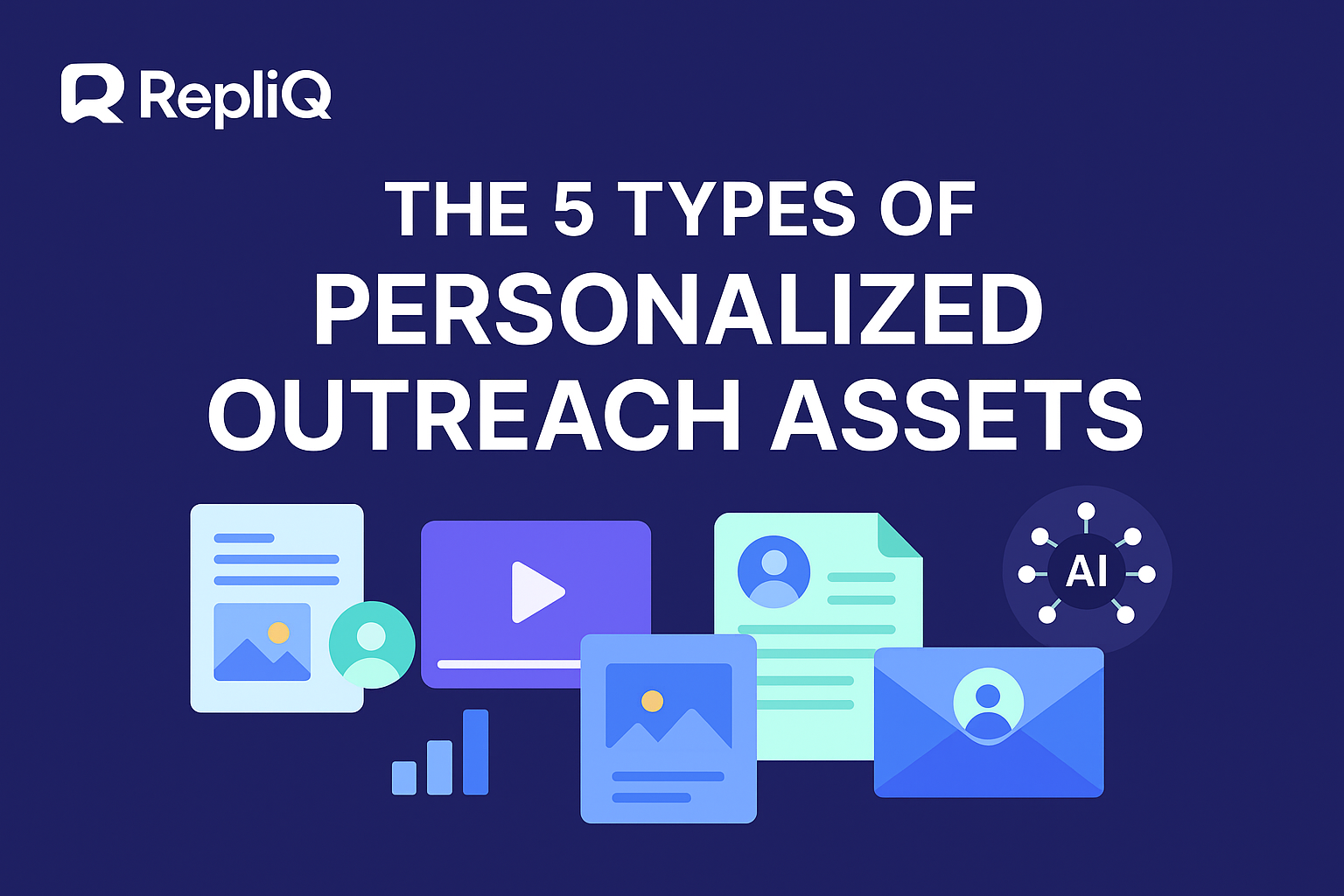
The 5 Types of Personalized Outreach Assets Every Agency Should Use (and How to Scale Them with AI)
Cold outreach is facing a crisis of sameness. Agencies today struggle with declining reply rates not because their offer is bad, but because their outreach looks identical to the hundreds of other emails flooding their prospects' inboxes. The era of "Insert First Name" as a personalization strategy is over; modern buyers demand relevance, context, and proof that you understand their specific business before they even click open.
To cut through the noise, agencies need a multi-format strategy that goes beyond text. Visual and contextual assets are no longer optional—they are the differentiator between a deleted email and a booked meeting. However, the challenge has always been scale: how do you produce high-quality, personalized visuals for thousands of leads without hiring an army of designers?
This article breaks down the 5 essential personalized outreach asset types every agency needs to master. We will explore how to deploy them across different funnel stages and, crucially, how to scale their production using AI without sacrificing the authenticity that drives conversions. Drawing from RepliQ’s experience producing large libraries of multi-format personalized assets for top-tier agencies, we will show you how to build a personalization engine that works.
Table of Contents
- Why Personalized Outreach Assets Matter
- The Five Core Asset Types and When to Use Each
- How Agencies Scale Personalization Without Losing Authenticity
- AI-Driven Workflows for High-Volume Asset Creation
- Case Studies & Examples
- Tools & Resources
- Future Trends
- FAQ
Why Personalized Outreach Assets Matter
Modern buyers have developed a subconscious filter for generic outreach. If an email looks like a template, it is treated like spam. The expectation for B2B communication has shifted: prospects expect hyper-relevance. They engage with content that demonstrates immediate value and proves that the sender has done their homework.
The pain points for agencies are clear: low reply rates, the high cost of manual customization, and a lack of differentiated assets. When every competitor is using the same text-based scripts, the agency that uses visual proof stands out.
Data supports this shift. Personalized emails have been shown to generate 29% higher open rates, while campaigns utilizing personalized videos can see 2–5x increases in reply rates compared to text-only baselines. But it isn't just about splashing a name onto an image; it is about matching the right asset to the right stage of the funnel. A prospect who doesn't know you needs a different visual hook than one who is considering a proposal.
Furthermore, as agencies adopt AI to solve these problems, maintaining trust is paramount. Authenticity in outreach is critical. Agencies must balance automation with ethical standards, adhering to frameworks like the CMS guidance on responsible AI use to ensure that agency outreach personalization remains respectful, compliant, and human-centric.
The Five Core Asset Types and When to Use Each
Not all personalization is created equal. Successful agencies view their outreach assets as a strategic toolkit. Some assets are designed for speed and attention (open rates), while others are designed for depth and trust (conversion rates).
Below is a breakdown of the five core types of personalized outreach assets, detailed by workflow complexity and ROI.
Personalized Images (Cold Email Openers)
Personalized images are the most effective tool for immediate attention capture. In a crowded inbox, a visual thumbnail is processed by the brain 60,000 times faster than text. These assets are best used at the top of the funnel—in cold email openers or LinkedIn connection requests—to disrupt the prospect's scrolling pattern.
Common examples include:
- Name-in-image: Incorporating the prospect’s name onto a coffee cup, a whiteboard, or a conference badge.
- Page Mockups: Showing the prospect's current website inside a device frame (laptop or mobile) to imply a review is taking place.
- Contextual Props: Using industry-specific imagery that aligns with the prospect's niche.
Agencies using personalized images for outreach report significantly higher click-through rates because the recipient instantly recognizes the content as unique to them. Industry benchmarks consistently show that personalized visuals increase engagement by creating a "pattern interrupt" that text alone cannot achieve.
Personalized Videos (Mid-Funnel Converters)
While images capture attention, video builds trust. Personalized videos are powerful mid-funnel converters. They are most effective in replies, follow-up steps, or as a "pattern interrupt" when a lead has gone cold.
The strength of video lies in the human connection. Hearing a voice and seeing a face (even a digital avatar representing the sender) establishes rapport.
- Formats: Short talking-head clips addressing the prospect by name, or dynamic backgrounds displaying the prospect's LinkedIn profile or website while the sender narrates a value proposition.
Video personalization used to require hours of recording. Now, agencies can scale personalized video outreach to generate thousands of unique videos where the background and voice variables change dynamically for every lead.
Screenshot-Based Personalization (Contextual Relevance)
Screenshot-based personalization is the ultimate proof of research. This asset type involves capturing an image of the prospect's actual website, social profile, or software interface and using it as the background for the outreach message.
- Where to use: Follow-up emails, LinkedIn posts, and retargeting ads.
- Example: A marketing agency might send a screenshot of a prospect’s 404 error page with a message saying, "I found this broken link on your site—want me to fix it?"
This approach screams contextual relevance. It shows you aren't just guessing; you are looking at their specific digital real estate. By integrating screenshot personalization into your workflows, you transform abstract pitches into concrete, visual observations that demand a response.
Dynamic Hybrid Assets (Image + Video + Text)
Dynamic hybrid assets are composite creations that layer multiple forms of media. These are high-effort, high-reward assets typically reserved for high-value accounts (ABM strategies) or deep nurture sequences.
A hybrid asset might look like a video player (GIF thumbnail) embedded inside a personalized image frame, accompanied by overlay text that references the company's recent news.
- Use Case: A "mini-audit" where a video narrates over a scrolling screenshot of the prospect's website, with a personalized cover image inviting them to click.
These dynamic personalization assets signal a premium approach, distinguishing agencies as sophisticated partners rather than commodity service providers.
Script-Based Personalization (Smart, Text-Only Enhancers)
Sometimes, visuals aren't the right fit. Script-based personalization utilizes AI to generate highly contextual text intros or P.S. lines that go far beyond "I hope this finds you well."
- How it works: AI analyzes a prospect's website or recent LinkedIn posts to generate a unique "icebreaker" sentence.
- Example: "I saw your recent post about scaling renewable energy logistics—fascinating take on the supply chain challenges."
These sales personalization strategies are best used when visual assets might feel too aggressive or when you need to scale variations quickly for testing. They ensure that even the text component of your email feels bespoke.
How Agencies Scale Personalization Without Losing Authenticity
The biggest fear agencies face when adopting AI is the risk of "looking automated." Nothing kills a deal faster than a robotic, uncanny-valley message. To scale effectively, agencies must adopt human-first principles where AI supports, rather than replaces, authenticity.
Traditional manual workflows—where a SDR researches and writes every email—are authentic but impossible to scale. Conversely, bad automation is scalable but ineffective. The solution lies in the middle, supported by frameworks like the GCS generative AI policy which advocates for transparency and human oversight in automated communications.
The 80/20 Personalization Framework
To avoid automated-looking outreach personalization, successful agencies use the 80/20 framework:
- 80% Reusable Structure: The core value proposition, the offer, and the call-to-action remain consistent across the campaign. This ensures messaging clarity and brand control.
- 20% Customized Asset Layer: The visual hook (image/video) and the opening line are dynamically generated for each specific prospect.
This approach allows agencies to build sequences that feel 100% unique to the recipient while maintaining the efficiency of a template.
Matching Asset Types to Intent and Funnel Stage
Authenticity also means relevance. Sending a deep-dive audit video in a first cold touch can feel overwhelming. Agencies should map asset types to the funnel:
- Top of Funnel (TOF): Use Personalized Images. They are low-friction and easy to digest.
- Middle of Funnel (MOF): Use Screenshots + Videos. These provide evidence and build trust once interest is piqued.
- Bottom of Funnel (BOF): Use Hybrid Assets or Scripts. These address specific objections or negotiation points.
By aligning the types of personalized outreach assets with intent, the communication feels natural rather than forced.
Avoiding Over-Personalization Fatigue
There is such a thing as too much personalization. Mentioning a prospect's family dog found on Instagram or a personal hobby unrelated to business can feel creepy rather than attentive.
Guideline: Keep personalization strictly professional and relevant to the business problem you solve. Authentic outreach personalization focuses on the prospect's work, their company's goals, and public professional data. Balance automation with sincerity by ensuring every personalized element ties back to why you are reaching out.
AI-Driven Workflows for High-Volume Asset Creation
Scaling requires systems. Agencies cannot rely on pieced-together tools; they need unified AI-driven workflows. Platforms like RepliQ enable agencies to create large personalized libraries where images, videos, and text are generated in unison.
Workflow 1 — Bulk Asset Generation
This is the engine room of fast personalized outreach creation.
- Input: An agency uploads a CSV of leads (containing URLs, names, and company data).
- Process: The AI engine visits each URL, captures screenshots, overlays dynamic elements (like the prospect's logo), and renders a unique image for every row in the CSV.
- Output: A downloadable file or direct integration containing thousands of unique assets ready for upload to a sending platform.
Agencies must ensure these processes remain compliant with data handling standards. Referencing the GSA AI compliance plan, agencies should ensure that data scraping and processing workflows respect privacy limits and terms of service.
Workflow 2 — CRM/Pipeline Triggered Personalization
For more sophisticated setups, assets can be generated automatically based on CRM triggers.
- Trigger: A prospect visits the pricing page or books a demo.
- Action: The system automatically generates a personalized video addressing them by name and referencing the specific service page they visited.
- Result: A highly timely email is sent within minutes of the action.
This CRM personalization turns static automation workflows into responsive, active selling agents.
Workflow 3 — Multi-Format Outreach Kits
The most advanced agencies create "Outreach Kits" for their high-ticket prospects. Instead of a single asset, the AI generates a bundle: a personalized thumbnail for email, a screenshot for a LinkedIn DM, and a video for a follow-up.
Cross-format personalization tools allow these assets to be generated simultaneously, ensuring consistency across every channel the prospect frequents.
Case Studies and Real-World Examples
Agency A: The Pattern Interrupt
- Challenge: A lead generation agency was seeing open rates plateau at 35% using text-only cold emails.
- Solution: They implemented personalized images utilizing the "website background" technique—showing the prospect's own homepage with a subtle overlay of the agency's value prop.
- Outcome: Open rates jumped to 62%, and the reply rate increased by 3x. The visual proof that the agency had "visited" the site created immediate relevance.
Agency B: The Mid-Funnel Video
- Challenge: High drop-off rates after the initial positive reply. Prospects were ghosting before booking a call.
- Solution: The agency set up an automated workflow sending a personalized video 48 hours after a lead went silent. The video featured a dynamic background of the prospect's LinkedIn profile.
- Outcome: Re-engagement rates increased by 40%, recovering significant revenue from the "dead" pipeline.
These personalized outreach examples demonstrate that visual assets are not just aesthetic upgrades—they are performance multipliers.
Tools & Resources for Agencies
To execute this strategy, agencies need the right stack.
- Image Personalization Engines: Tools that allow layer-based editing and variable insertion.
- Video Generation AI: Platforms that clone voices or generate avatars to read dynamic scripts.
- Hybrid AI Engines (Recommended): Tools like RepliQ that combine image, video, and text generation into a single scalable workflow.
While single-format tools exist, AI outreach tools that handle multi-format generation are superior for scaling. They reduce the friction of moving data between different software and ensure a cohesive look across all asset types.
Future Trends & Expert Predictions
The future of outreach is hyper-contextual.
- Contextual Video Generation: AI will soon generate videos that not only use the prospect's name but visually analyze their website in real-time to point out specific elements on screen during the video.
- Hybrid Assets: We will see a rise in interactive assets where a prospect can click inside a personalized video to book a meeting without leaving the player.
- CRM-Triggered AI: Personalization will move from "batch and blast" to "real-time reaction," where assets are created the second a buying signal is detected.
AI personalization trends point toward a world where "generic" outreach ceases to exist entirely, and every communication is bespoke.
Conclusion
The agencies that win in the coming years will be those that refuse to be ignored. By moving beyond text and embracing multi-format personalized outreach assets, you honor your prospect's time and attention.
We have covered the five essential types: personalized images, videos, screenshots, hybrid assets, and smart scripts. Each has a specific role in the funnel, and each can be scaled using ethical, human-centric AI workflows.
The technology to build a relationship at scale is here. It is time to build your first multi-format personalized outreach library and turn your cold leads into closed deals.
FAQ
What type of personalized outreach asset generates the highest replies?
Data suggests that a combination of personalized video and contextual screenshots yields the highest ROI. The screenshot proves relevance, while the video builds the human trust required to reply. This "best outreach personalization format" creates a dual impact of logic and emotion.
How do agencies scale personalization quickly?
Agencies scale by adopting AI-driven workflows that separate the fixed message structure from the dynamic asset layer. By using templates that automatically pull data from CSVs or CRMs, agencies can generate thousands of unique assets in minutes. This is the secret to learning how to scale personalized outreach effectively.
How do you avoid automated-looking AI personalization?
To avoid automated-looking outreach, use the 80/20 framework and ensure your data sources are clean. Always include a human review step for high-value accounts. Adhering to authenticity guidelines ensures your message lands as sincere rather than robotic.
When should agencies use images vs videos?
Use images for top-of-funnel cold outreach to capture immediate attention and boost open rates. Use videos for mid-to-bottom funnel interactions (replies, follow-ups) where building trust and explaining complex value propositions is necessary. This image vs video outreach strategy aligns with buyer psychology.
Which personalization formats work best for cold email?
For cold email personalization, personalized images (like name-in-image or website mockups) and contextual screenshots are the top performers. They are lightweight, load instantly, and provide the visual "pattern interrupt" needed to get a prospect to read the first sentence.

.svg)
.png)


.svg)