.png)
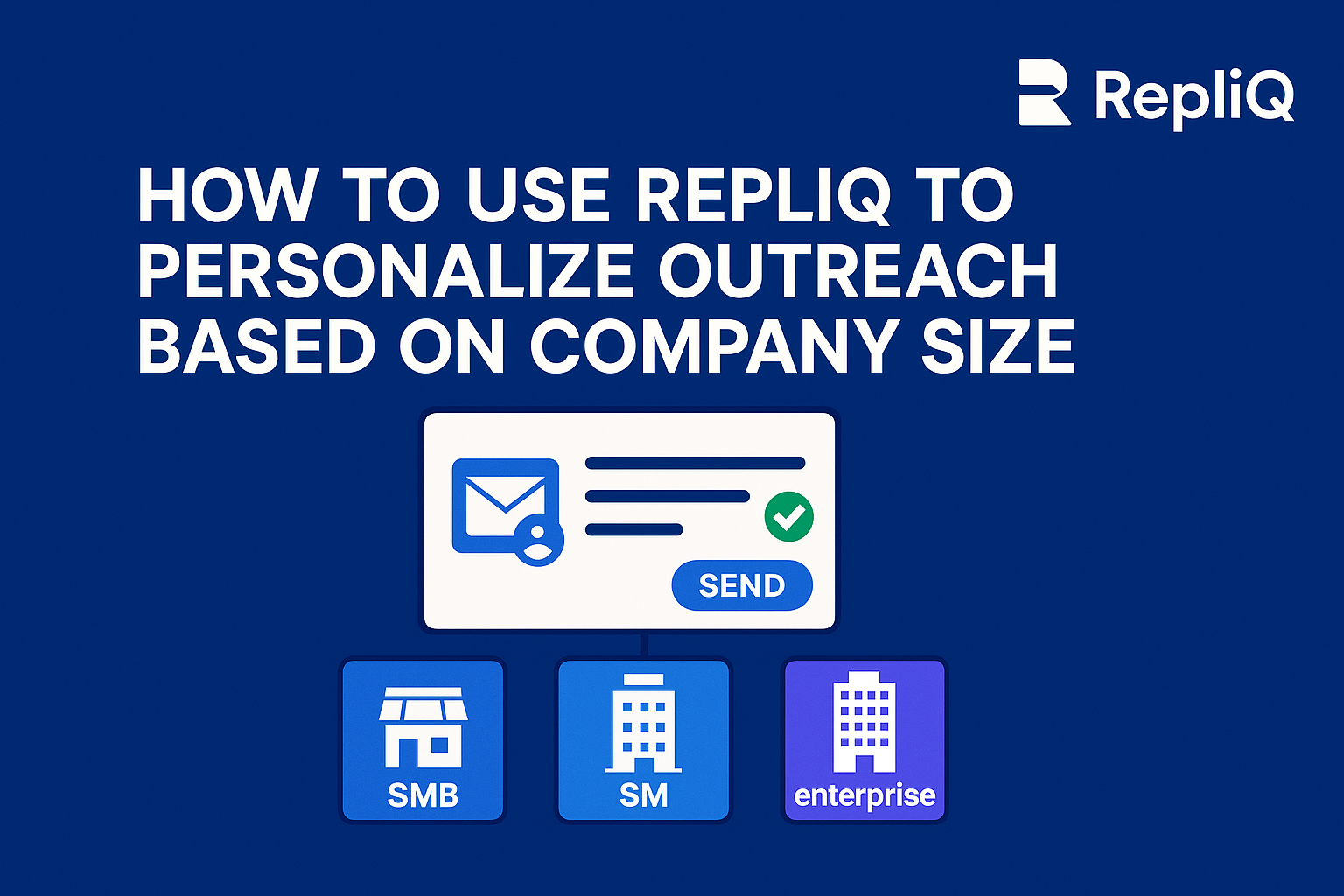
Company Size Personalization: How to Use RepliQ for SMB and Enterprise Outreach That Converts
Most outbound teams personalize their cold emails by citing a prospect’s first name, current role, or a recent company milestone. Yet, despite these customized tokens, they still send nearly the exact same pitch to a 20-person agile startup as they do to a 20,000-person highly regulated enterprise. This approach is fundamentally flawed.
Generic outreach underperforms because company size drastically alters a buyer’s urgency, operational complexity, proof requirements, and call-to-action (CTA) friction. Treating an enterprise director like a small business owner—or vice versa—kills your conversion rates before the email is even fully read.
This guide will show you how to turn company-size signals into a repeatable, high-converting outreach system. We will cover exactly why company size affects reply rates and relevance, how SMB, mid-market, and enterprise buyers evaluate messages differently, and a practical segmentation framework for adjusting your pitch, proof, CTA, and destination experience. Finally, we will demonstrate how to operationalize this at scale. As a practitioner brand focused on advanced personalization workflows, RepliQ goes beyond generic outbound theory to help you build tailored prospect experiences. If you want to master company size personalization and elevate your smb enterprise outreach, read on.
Table of Contents
- Why Company Size Changes Outreach Performance
- How SMB, Mid-Market, and Enterprise Buyers Differ
- A Framework for Segmenting Messaging by Company Size
- Examples of Value Props, Proof Points, and CTAs by Segment
- How to Personalize at Scale With RepliQ
- Future Trends in Company-Size-Based Personalization
- FAQ
Why Company Size Changes Outreach Performance
Company size personalization is not a cosmetic marketing tactic; it reflects tangible, real-world differences in how buyers evaluate software and services. A one-size-fits-all approach feels irrelevant across segments because a company's headcount and revenue directly dictate its operational realities.
Company size impacts operational complexity, the number of stakeholders involved in a purchase, budget scrutiny, implementation expectations, and internal risk tolerance. According to the OECD on SME digital adoption by firm size, firm size heavily influences technology adoption patterns, meaning a pitch that resonates with a small business will often be dismissed by a larger corporation. While the SBA small business size standards provide an authoritative grounding point for defining what constitutes a smaller firm, sales teams often use simpler internal buckets for outreach. The key takeaway is that sales personalization by segment should reshape your entire message architecture, not just the wording.
Why Generic Outreach Breaks Across Segments
The exact same message simply cannot serve buyers operating under vastly different constraints and purchasing processes. When outbound teams ignore firmographics, mismatch inevitably happens. SMBs end up receiving bloated enterprise messaging that sounds too expensive and complicated. Conversely, enterprise teams receive shallow, generic value props that fail to address integration, security, or scale. Furthermore, using uniform CTAs creates friction across different buying cycles. SDR leaders and outbound marketers desperately need a scalable framework for their prospecting by company size, rather than relying on ad hoc copywriting that misses the mark.
The 4 Levers That Should Change by Company Size
To execute effective account-based personalization, you must adjust four core levers in your B2B personalization by firmographics:
- Pitch: How you frame the value and core problem.
- Proof: The evidence and case studies you provide.
- CTA: The action you are asking the prospect to take.
- Destination experience: The landing page or asset the prospect sees after clicking.
These four levers create a highly practical lens for message design and campaign review, forming the foundation of a successful company size outreach strategy.
How SMB, Mid-Market, and Enterprise Buyers Differ
To craft compelling outreach messaging for enterprises versus smaller firms, you must first understand how buyer psychology and purchasing processes shift as headcount grows. Decision speed, stakeholder count, implementation complexity, internal risk, and expected proof all scale with company size. The goal here is to translate these buyer differences into precise messaging decisions.
SMB Buyers: Speed, Simplicity, and Immediate ROI
SMB buyers are heavily constrained by time and resources. As highlighted in the OECD overview of SME digitalisation barriers, smaller firms prioritize practicality, constraints, and accessibility. Therefore, SMB buyers care most about fast time-to-value, absolute ease of adoption, clear business outcomes, and low friction during evaluation.
Dense messaging, long-winded implementation narratives, or overbuilt enterprise proof will quickly overwhelm smaller teams. Your SMB outreach personalization must emphasize brevity, clarity, and highly practical outcomes. Cold email personalization for this segment should get straight to the point: how can you save them time or make them money this week?
Mid-Market Buyers: Balance Between Agility and Process
Mid-market companies represent a transitional phase. They are the segment where outreach often needs to demonstrate both immediate business impact and long-term operational fit. These buyers typically have more established processes than SMBs, but they lack the heavy bureaucracy of a massive enterprise.
For effective mid-market outreach, your personalized outreach by company size must strike a balance. You need to highlight efficiency and team coordination while also proving scalability and implementation confidence. Sales personalization by segment here means showing that your solution can grow with them without requiring a six-month onboarding process.
Enterprise Buyers: Risk, Governance, and Stakeholder Alignment
Enterprise outreach personalization must account for a highly complex buying environment. You are navigating multiple stakeholders, strict internal approval layers, heightened supplier risk concerns, and rigorous integration and governance questions. Simplistic messaging fundamentally underperforms here, even if it includes the prospect's name and title.
Enterprise buyers need proof and process, not just surface-level relevance. They need to know you meet their compliance standards. For instance, referencing frameworks like the NIST guide to supplier requirements and risk management when discussing enterprise evaluation criteria can demonstrate that your organization understands governance and supplier scrutiny. Account-based personalization at this level is about minimizing perceived risk.
A Framework for Segmenting Messaging by Company Size
Strategic consistency is the key to scaling company size personalization. You do not need to manually reinvent every single email; instead, you need a step-by-step model for turning company size data into smart message variation. Here is how to build that framework.
Step 1: Define Clear Company-Size Buckets
Start by recommending simple, operational buckets such as SMB, mid-market, and enterprise. While official frameworks like the SBA small business size standards provide a baseline, outbound teams should adapt these buckets to fit their specific Go-To-Market (GTM) model and Ideal Customer Profile (ICP). Exact employee counts or revenue thresholds will vary by team and market. The critical factor is internal consistency. Your buyer segmentation by company size must align directly with how your sales team views deal complexity and buying motions to ensure your company size outreach strategy is actually actionable.
Step 2: Map Pain Points, Urgency, and Complexity by Segment
Next, identify the likely segment-specific pain points. For SMBs, the pain is often limited time, lean teams, and immediate ROI pressure. For the mid-market, the focus shifts to scaling processes and improving cross-functional coordination. For the enterprise, the dominant pains are governance, change management, and building stakeholder consensus. Good prospecting by company size reflects this likely business context, not just demographic data. Map out these hypotheses before writing any copy to ensure your B2B personalization by firmographics is strategically sound.
Step 3: Adjust the Pitch for Each Segment
The same core product must be framed differently depending on the audience. This is where most teams fail—they keep the exact same value proposition and only tweak the intro line.
- SMB: Position your pitch around speed, simplicity, and immediate results.
- Mid-Market: Frame the pitch around efficiency, team leverage, and bridging silos.
- Enterprise: Focus your pitch on scale, administrative control, and risk reduction.
Adjusting your pitch ensures your personalized outreach by company size resonates with the actual daily realities of the recipient.
Step 4: Match Proof Points to Buyer Expectations
Social proof must change by segment. SMBs want relatable wins and fast outcomes—they want to see that companies just like theirs succeeded quickly. Enterprise buyers, however, demand credibility, scale, and process confidence. Your proof points should include highly relevant customer examples, specific use-case relevance, implementation signals, and stakeholder-fit language. Relying on the same case study for every account is a hallmark of weak account-based personalization. Tailor the evidence to the audience.
Step 5: Change the CTA Based on Buying Cycle and Friction
A CTA should align seamlessly with how each segment prefers to buy. One universal CTA across all segments drastically lowers response quality.
- SMB: Use a low-friction CTA like a quick 10-minute demo, a short video walkthrough, or a simple introductory chat.
- Mid-Market: Offer a tailored review or a workflow discussion.
- Enterprise: Propose a strategic consultation or a stakeholder-specific conversation that respects their longer evaluation cycle.
Your CTA by segment is a critical part of successful smb enterprise outreach.
Step 6: Align the Destination Experience
Post-click personalization must reinforce the exact same segment logic used in your cold email. Driving an enterprise prospect to a generic, SMB-focused landing page breaks the illusion of relevance. Personalized landing pages and dynamic prospect experiences should visually and contextually reflect the segment-specific pain points, relevant proof, and tailored next steps you promised in the email. This end-to-end alignment is what separates true account-based outreach personalization from superficial email hacks.
Examples of Value Props, Proof Points, and CTAs by Segment
To make this framework concrete, let’s look at how outreach messaging for SMBs differs from outreach messaging for enterprises in practice. These personalized cold outreach examples demonstrate how to alter your message architecture.
SMB Example
For an SMB, the value proposition must focus on speed, simplicity, and immediate business benefit. The messaging structure should be short, the CTA low-friction, and the proof attainable. Avoid heavy technical or enterprise-style jargon.
- Pitch: "We help lean teams automate their invoicing so you spend less time chasing payments and more time growing the business."
- Proof: "We recently helped [Similar SMB] cut their weekly admin time by 5 hours within the first week of using our tool."
- CTA: "Mind if I send over a 2-minute video showing how it works?"
This cold email personalization works because it respects the SMB's time and promises fast, practical relief.
Mid-Market Example
Mid-market messaging must bridge tactical value and operational scalability. The proof should suggest team fit and process improvement without sounding overengineered, and the CTA should invite exploration without demanding a massive commitment.
- Pitch: "As your team scales, manual invoicing creates bottlenecks. We help mid-sized finance teams standardize their billing workflows without requiring a massive IT overhaul."
- Proof: "Teams like [Similar Mid-Market Company] used our platform to align their sales and finance data, reducing billing errors by 40% last quarter."
- CTA: "Are you open to a brief chat about how your team is currently handling billing workflows at scale?"
This sales personalization by segment shows an understanding of growing pains and operational efficiency.
Enterprise Example
An enterprise-oriented message structure requires stronger context, strategic framing, and proof tied to scale, governance, or stakeholder concerns. The CTA must respect a long, complex evaluation cycle.
- Pitch: "Managing global billing compliance across multiple subsidiaries introduces significant risk. We provide a centralized, secure financial automation platform designed for complex enterprise environments."
- Proof: "Organizations like [Enterprise Competitor] rely on us to maintain compliance and standardize billing across 15 regions. Our infrastructure aligns seamlessly with standards like the NIST guide to supplier requirements and risk management, ensuring secure integration."
- CTA: "Would it be valuable to schedule a strategic review of how we map to your current enterprise resource planning initiatives?"
This enterprise outreach personalization feels credible, authoritative, and risk-aware, rather than verbose or pushy.
Common Mistakes When Personalizing by Company Size
The most common errors in company size outreach strategy occur when teams execute segmentation poorly. These include:
- Only changing the first line while leaving the core pitch generic.
- Using dense enterprise jargon for SMB outreach.
- Underselling complexity and security in enterprise messaging.
- Using the exact same CTA for every segment.
- Personalizing the email copy but sending all prospects to the same generic destination page.
Segmentation alone is not enough without purposeful message design and destination relevance. Generic personalization workflows fail because they lack this strategic depth.
How to Personalize at Scale With RepliQ
Connecting this strategic framework to daily execution requires the right workflow. RepliQ serves as the execution layer that helps teams turn firmographic segmentation into tailored, high-converting outreach experiences. For more insights on building advanced outbound systems, you can explore the [INTERNAL_LINK: https://repliq.co/blog]. Here is how to use RepliQ for effective company size personalization.
Use Company-Size Signals to Drive Personalization Logic
Teams can start with firmographic segmentation before sequence enrollment. By using company-size signals, you can trigger different message structures, proof choices, and CTAs automatically. This AI-assisted personalization workflow reduces guesswork for SDRs and ensures strategic consistency across all reps, ensuring your prospecting by company size is operationalized effectively.
Generate Personalized Lines That Reflect Segment Context
RepliQ allows you to generate personalized lines that go far beyond basic first-name tokens. You can build context-rich relevance based on company maturity, likely operational realities, and segment-specific priorities. The output remains highly human and focused, avoiding the robotic tone of over-automated tools. Utilizing [INTERNAL_LINK: https://repliq.co/personalized-lines] provides a practical tool for creating segment-aware, compelling first-touch messaging.
Tailor the Destination Experience for SMB vs Enterprise Prospects
RepliQ extends personalization beyond the inbox and into the destination experience. Depending on the segment, you can dynamically alter headline framing, proof selection, CTA types, and overall page structure. Sending an enterprise prospect to a dynamically generated page that highlights compliance and scale—while sending an SMB to a page highlighting speed and ease of use—creates a cohesive, account-based outreach personalization journey that dramatically lifts conversions.
Build a Repeatable Workflow for SDR and Marketing Teams
To scale this, build a repeatable operational workflow: assign the company-size bucket, map the segment hypothesis, select the appropriate message variant, align the proof and CTA, and personalize the destination experience. By creating robust outbound sequences and templates by segment—rather than writing one-off custom copy for every single account—teams can achieve deep sales personalization by segment without creating heavy manual research overhead.
How RepliQ Differs From Generic Personalization Workflows
Most tooling approaches focus mainly on filters, data enrichment, basic sequencing, and simple variable insertion. RepliQ differentiates itself by connecting company context to the actual pitch, seamlessly changing proof and CTAs by segment, and aligning the post-click experience with the initial outreach. This end-to-end capability is what makes RepliQ the premier choice for mastering smb enterprise outreach and true account-based personalization.
Future Trends in Company-Size-Based Personalization
The outbound market is rapidly moving beyond token-based personalization toward context-aware workflows. According to McKinsey research on B2B buyer channel preferences, evolving buyer expectations demand highly tailored outreach experiences. Buyers now expect vendors to understand their specific firmographic context before reaching out.
Emerging trends include AI-assisted personalization workflows tied deeply to firmographics, dynamic micro-landing pages generated on the fly, and rigorous account-based segmentation taking place long before sequence enrollment. There is immense pressure on sales teams to personalize deeply without proportionally increasing manual effort. Teams that build intelligent segment logic now will be vastly better positioned as these B2B personalization by firmographics expectations continue to rise across the industry.
Conclusion
Company size personalization works because SMB, mid-market, and enterprise buyers simply do not evaluate messages the same way. A generic pitch ignores the reality of their daily operations. By utilizing the four-part framework—adjusting your pitch, proof, CTA, and destination experience—you can dramatically increase your relevance and reply rates.
Stop treating personalization as a mere first-line exercise and start treating it as a foundational segmentation strategy. To get started today, audit one of your current outbound sequences. Build separate SMB, mid-market, and enterprise variants. Then, learn how to use RepliQ to turn that strategy into personalized lines and tailored prospect experiences at scale, achieving more relevance with significantly less manual effort.
FAQ
Why does company size matter in outreach personalization?
Company size shapes urgency, budget processes, operational complexity, and the number of stakeholders involved in a buying decision. Better personalization reflects these tangible business realities, ensuring your message resonates deeply rather than just relying on surface-level tokens.
How should outreach differ for SMBs vs enterprises?
SMBs respond best to simplicity, speed, immediate ROI, and low-friction CTAs. Conversely, enterprises require stronger proof of scale, more strategic framing regarding risk and governance, and stakeholder-aware next steps that respect longer, more complex evaluation cycles.
What data points should teams use to segment outreach by company size?
Company size (employee headcount or revenue) is the primary firmographic data point. However, teams should also consider related context such as team maturity, likely operational complexity, and the specific relevance of the prospect's role within that size bracket to inform their buyer segmentation.
How much personalization is enough for scaled outbound campaigns?
The right level of personalization provides enough context to reflect the segment's realities without forcing SDRs to conduct fully manual research for every prospect. Utilizing reusable segment templates, dynamic variables, and tailored destination experiences allows you to personalize at scale efficiently.
How can RepliQ help personalize outreach by company size?
RepliQ turns segmentation strategy into automated execution. It helps teams generate highly relevant personalized lines, deploy segment-aware messaging, and create dynamic, tailored destination experiences, allowing you to master company size personalization with ease.

.svg)
.png)


.svg)