
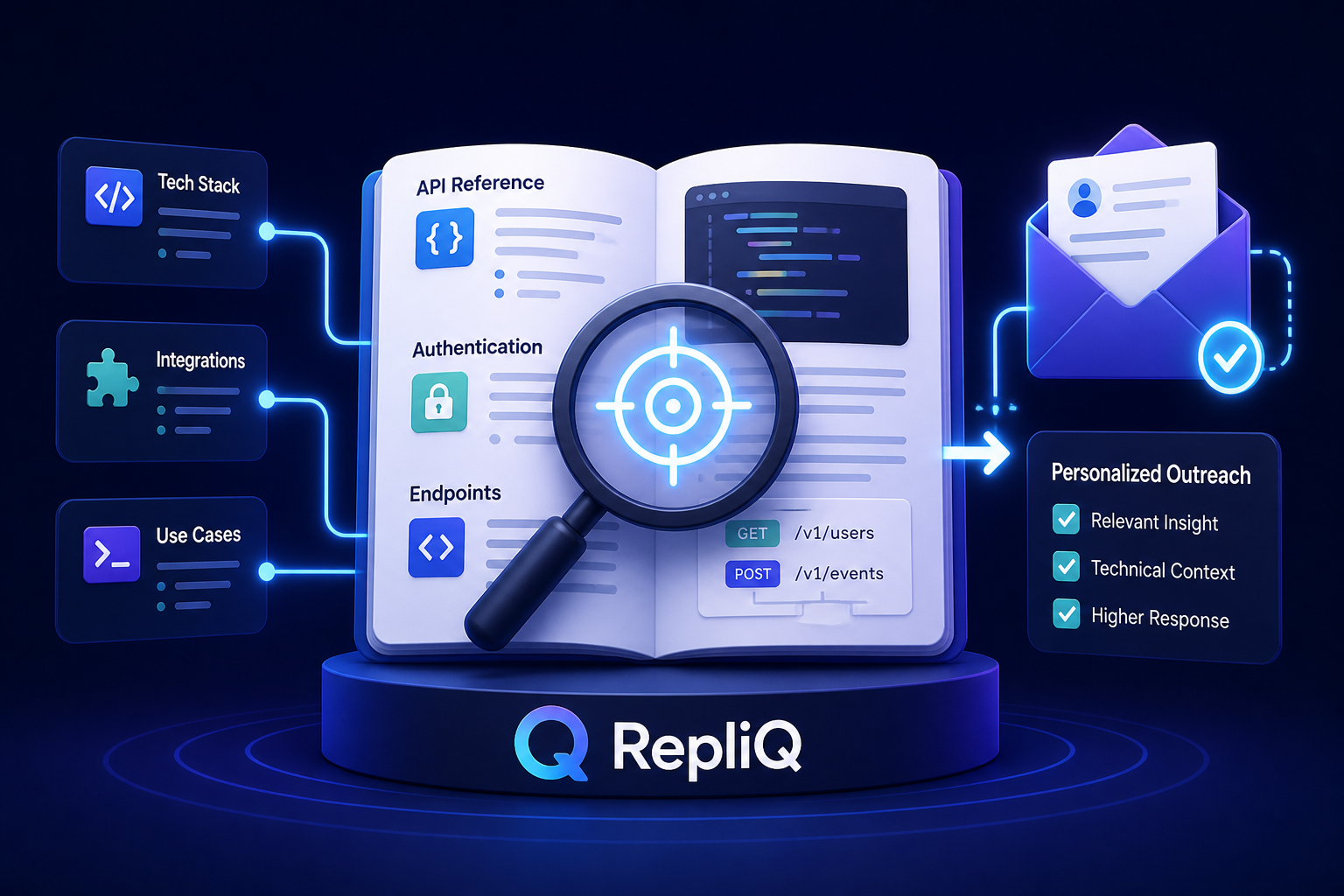
How to Personalize Outreach Using a Prospect’s Technical Documentation
Relying on firmographics, job titles, and broad technographic data often produces outreach that sounds personalized but says little about how a prospect actually builds, integrates, or evaluates software. True personalization requires context. This is where technical documentation personalization shines. By examining a prospect’s API references, SDKs, authentication guides, webhooks, changelogs, integration pages, tutorials, and architecture documentation, you unlock a higher-context research source.
This article will show advanced sales, marketing, and developer-facing teams how to turn documented technical evidence into credible outreach hypotheses without overstating what the evidence proves. The core distinction lies in how you interpret the data: an observation is what the prospect’s documentation explicitly shows; an inference is a reasonable hypothesis about implementation, priorities, or friction; and an assumption is an unverified claim that should never be used as fact in outreach.
We will explore a repeatable workflow: find relevant documentation, extract signals, score evidence, map signals to persona-specific needs, validate the hypothesis, and write the message. Documentation-led personalization is far more defensible than simply inserting a company name or detected technology into a template. However, it is a research methodology, not a guarantee that it will improve every campaign. Success requires balanced language around relevance, trust, privacy, and measurable outcomes. For teams looking to operationalize this approach, RepliQ is a destination for scalable research and personalization workflows that rely on verifiable SaaS prospect research to elevate developer outreach.
Table of Contents
- Why Technical Documentation Is a High-Context Prospecting Signal
- What to Look for in a Prospect’s Technical Resources
- How to Separate Evidence From Assumptions
- Turning Technical Signals Into Role-Specific Outreach
- A Repeatable Documentation-to-Message Workflow
- Technical Personalization Examples
- Validation, Compliance, and Ethical Boundaries
- How to Scale and Measure Documentation-Led Outreach
- FAQ
Why Technical Documentation Is a High-Context Prospecting Signal
Developer resources reveal significantly more useful context than surface-level firmographic or generic technographic data. While firmographic personalization relies on broad categories like industry or company size, and technology-stack enrichment merely identifies tools without explaining their use, technical documentation exposes implementation patterns. It highlights integration priorities, supported workflows, technical maturity, and likely evaluation criteria. Job-title personalization often ignores the recipient’s current technical priorities, whereas documentation focuses precisely on the systems they build and manage.
This methodology should complement, not replace, direct discovery and first-party qualification. The strongest outreach connects an observed technical detail to a relevant business or implementation hypothesis. However, the value of SaaS prospect research depends entirely on the documentation’s recency, specificity, and accessibility. Technical documentation is not inherently more accurate than technographic databases; its utility hinges on whether the resource reflects current production systems or merely aspirational capabilities.
Standard sales-engagement workflows typically scale data collection and sequencing. By contrast, analyzing technical buying signals and software stack research focuses on interpreting documentation-level evidence accurately to ensure outreach is highly relevant.
What Technical Documentation Can Reveal
Different categories of documentation indicate distinct technical realities:
- API references: Reveal available capabilities, endpoints, resources, and integration scope.
- SDKs: Highlight preferred programming languages, developer experience priorities, and implementation support.
- Authentication guides: Outline security expectations, access models, and integration complexity.
- Webhooks: Indicate event-driven workflows and real-time data requirements.
- Changelogs and migration guides: Expose active product development, breaking changes, or adoption friction.
- Integration catalogs: Show ecosystem priorities and supported third-party workflows.
- Tutorials and sample applications: Suggest recommended use cases and expected implementation paths.
- Architecture or deployment documentation: Detail infrastructure, scalability, and operational considerations.
Every API documentation analysis or review of developer resources should interpret these elements as technical discovery research signals, rather than definitive proof of a prospect's internal architecture.
Why Documentation Quality and Recency Matter
Outdated or incomplete documentation inevitably produces inaccurate technical documentation personalization. Before drafting outreach, check publication dates, changelog activity, version numbers, migration notices, and archived pages to ensure consistency across related resources.
You must distinguish between:
- A currently supported integration.
- A legacy endpoint still documented for backward compatibility.
- A roadmap or aspirational feature.
- A tutorial demonstrating possibility rather than actual adoption.
A practical rule for writers: never state that a prospect “uses” a technology when the documentation only shows that the technology is supported. Accurate prospect technology assessment relies on interpreting technical signals with caution.
What to Look for in a Prospect’s Technical Resources
Advanced researchers need a structured documentation audit that can be repeated across accounts. Begin with the prospect’s developer portal, API reference, integration directory, and changelog before moving into deeper technical pages.
During your API documentation analysis, record the page URL, documentation type, observed fact, date or version, likely relevance, and your confidence level. Prioritize these technical buying signals by:
- Specificity: Does the resource reveal a concrete implementation detail?
- Recency: Is the information current or recently updated?
- Relevance: Does it connect to the recipient’s likely role or workflow?
- Actionability: Can it support a useful question, proof point, or resource?
This structured integration research for sales forms the foundation of credible outreach.
API References and Endpoint Design
When reviewing an API reference, inspect resource names, object models, and common endpoint groups. Look closely at filtering, pagination, bulk operations, and rate-limit documentation. Note any versioning, deprecation notices, and error-handling guidance.
An API reference can suggest implementation complexity without proving that the prospect is experiencing a specific problem. Map your observations to cautious hypotheses for API-first SaaS prospecting:
- Multiple endpoint families may suggest a broad integration surface.
- Detailed rate-limit guidance may indicate scale-sensitive implementation.
- Version migrations may indicate a need to manage compatibility or engineering effort.
Avoid dumping technical terminology into your integration-specific messaging unless it directly helps the recipient contextualize your question.
SDKs, Libraries, and Sample Applications
Identify language-specific SDKs, package managers, code examples, starter repositories, and sample applications. These developer resources reveal the implementation environments the prospect prioritizes.
Personalize responsibly: reference a documented SDK or example only when relevant to the recipient’s role. Use the detail to offer a technical resource, implementation comparison, or discovery question. Do not infer the prospect’s internal programming language solely from the presence of an SDK.
Useful evidence notes for developer outreach include:
- “The public developer portal includes a Python SDK.”
- “The documentation provides a sample workflow for event-driven synchronization.”
This level of developer-focused personalization proves you have conducted genuine technical discovery research.
Authentication, OAuth, Webhooks, and Data Flows
Authentication documentation reveals critical details about OAuth requirements, API keys, service accounts, scope management, token refresh flows, and environment separation. Webhook documentation indicates event-driven use cases, synchronization requirements, and operational dependencies.
Whether a prospect documents REST API integration or GraphQL, note the approach without assuming one is inherently better. Connect these observations to role-specific concerns:
- Developers care about implementation effort and failure handling.
- Security stakeholders care about permissions, data access, and auditability.
- Business stakeholders care about time-to-value and reliability.
Webhook integration and data flow signals provide an excellent entry point for developer outreach when framed around these specific priorities.
Changelogs, Migration Guides, and Integration Pages
Changes are often more timely than static documentation. Look for new endpoints, new SDK releases, deprecations, expanded integrations, or updated authentication guidance. A recent documentation change can serve as a highly relevant event-based outreach trigger.
Writers must distinguish between a documentation update, a product launch, a migration requirement, and a change that directly affects the recipient’s likely workflow. Reference the change as a neutral observation rather than implying urgency or internal disruption. This keeps your integration research for sales grounded in verifiable SaaS technical discovery and credible technical buying signals.
How to Separate Evidence From Assumptions
To prevent inaccurate or invasive personalization, you must establish a defensible research framework. This requires a three-layer evidence model:
- Documented fact: A detail directly supported by a public page.
- Reasonable hypothesis: A possible implication that requires validation.
- Unsupported assumption: A claim that should be strictly excluded from outreach.
Maintain an evidence table with columns for the source URL, documentation category, exact observation, recency indicator, potential relevance, confidence score, and suggested validation question.
Score your evidence rigorously:
- High confidence: Recent, specific, first-party, and directly relevant.
- Medium confidence: Credible but indirect or lacking recency.
- Low confidence: Generic, ambiguous, outdated, or based on a third-party interpretation.
Technical documentation personalization requires accuracy and transparent uncertainty. Technical credibility is instantly damaged when technical account research turns “the documentation supports X” into “your team is currently struggling with X.”
Observation-to-Hypothesis Mapping
Use a repeatable format to structure your technical discovery research:
- Observation: The prospect documents webhook retries and event delivery failures.
- Hypothesis: Teams integrating event-driven workflows may care about monitoring or reliability.
- Validation question: “How are you currently handling event delivery failures across integrations?”
- Relevant proof: A technical guide, architecture example, or implementation resource.
Apply this to various scenarios, such as OAuth permission scopes, GraphQL query complexity, API version migrations, multiple third-party integrations, or data synchronization. Your integration-specific messaging must lead with the observation and question—never an unverified conclusion.
Identifying Stale, Aspirational, or Ambiguous Documentation
When conducting software stack research, actively look for old version numbers, broken links, inconsistent endpoint names, deprecated features, and conflicting instructions. A lack of recent changelog activity or language such as “planned,” “coming soon,” or “beta” indicates ambiguous technical signals.
Phrase uncertain findings carefully. Use “I noticed your documentation describes…” rather than “Your team has implemented…” Ask whether a capability is active, planned, or simply being evaluated. Advise against mentioning private infrastructure, inferred employee behavior, or sensitive operational details not explicitly presented for public use in your prospect technology assessment.
Turning Technical Signals Into Role-Specific Outreach
The same documentation detail can support entirely different messages for engineering, security, product, and business stakeholders. Technical personalization is not about adding more jargon; it is about connecting relevant evidence to the recipient’s likely responsibilities.
Build a signal-to-message matrix containing the documentation signal, possible technical implication, relevant persona, business or implementation concern, validation question, and useful resource. Choose one primary signal per message rather than listing every technical detail discovered to keep your integration-specific messaging focused.
Outreach for Engineering and Developer Personas
When messaging engineering personas, focus on implementation friction, documentation clarity, testing, observability, reliability, versioning, and developer experience. Use concise technical observations supported by a source page.
Offer a relevant next step, such as comparing implementation approaches, sharing a technical walkthrough, reviewing an integration workflow, or asking how the team handles a documented challenge. Avoid pretending to know the team’s architecture or current blockers.
Example message direction: Reference a documented API or webhook workflow, then ask how the team manages the corresponding integration step at scale. This approach grounds developer-focused personalization in reality.
Outreach for Technical Buyers, Security, and Operations
Translate technical evidence into operational concerns such as integration risk, access control, data governance, reliability, deployment effort, and operational ownership. Do not assume that a developer-facing feature is the recipient’s primary buying priority.
Use the documentation as context for a focused question rather than as proof of a business problem. Include a lightweight technical validation step before proposing a sales conversation. This respects the SaaS technical discovery process and leverages technical buying signals accurately.
Outreach for Product and Business Stakeholders
For product and business leaders, translate implementation signals into outcomes. Focus on faster partner or customer integrations, reduced time-to-value, improved adoption of an API, lower support burdens, and more predictable delivery.
Keep technical detail proportional to the recipient’s role. A product leader may care about the same API change as an engineer, but they care about the business impact, not the code. Include one technical proof point and one business implication to ensure your personalized B2B outreach resonates.
A Repeatable Documentation-to-Message Workflow
To turn this research framework into an operational process across accounts, follow a structured workflow. For teams looking to scale these repeatable research, content, or personalization workflows, resources like the RepliQ Blog offer valuable insights.
The workflow consists of six steps:
- Define the account and recipient hypothesis.
- Locate and prioritize first-party technical resources.
- Extract documented observations.
- Score evidence for recency, specificity, confidence, and relevance.
- Convert the strongest signal into a role-specific hypothesis.
- Write, validate, and measure the outreach.
Create a compact account research brief before drafting the email. This supports both one-to-one technical account research and scalable personalization, provided human review remains a mandatory step.
Step 1 — Define the Research Question
Start your SaaS prospect research with a specific question:
- “What integration priority might this account be evaluating?”
- “Which documented implementation detail is relevant to this engineering persona?”
- “What evidence could support a credible discovery question?”
Avoid collecting technical facts without a planned use. Match the research question to your campaign objective and recipient role to ensure your account-based outreach remains focused.
Step 2 — Build the Documentation Evidence Log
Capture the page title, URL, resource type, exact technical observation, version or update date, confidence level, and potential relevance. Quote or paraphrase only what the source actually supports. Create separate fields for facts, hypotheses, and questions to validate. This rigorous API documentation analysis ensures your prospect technology assessment relies on concrete technical signals.
Step 3 — Select One Message-Worthy Signal
Prioritize signals that are specific enough to demonstrate real research, recent enough to be credible, and relevant to the recipient. The signal must connect to a useful question or resource.
Avoid combining unrelated endpoints, SDKs, and integrations in one message. A single defensible signal is usually stronger than a long list of technical observations, resulting in highly effective integration-specific messaging and developer-focused personalization.
Step 4 — Draft the Outreach Around Relevance, Not Surveillance
Structure personalized developer sales emails simply:
- Specific, source-backed observation.
- Cautious implication or reason for reaching out.
- Relevant technical or business value.
- Low-friction validation question.
- Clear, respectful next step.
Use language such as “I noticed…”, “Your documentation describes…”, “I’m curious whether…”, or “Is this an active priority, or mainly a supported use case?” Avoid language that implies monitoring, hidden tracking, or certainty about internal priorities. Proper technical documentation personalization respects boundaries.
Step 5 — Validate Before Sending
Require a technical reviewer or campaign owner to check whether the referenced page is live, whether the message accurately represents the documentation, and whether the recipient will understand the terminology. Ensure the proposed value is relevant and that the message does not expose unnecessary research detail.
Include a strict stop condition: if the only available signal is vague or stale, send a less personalized message or conduct more technical discovery research.
Technical Personalization Examples
These examples serve as illustrative patterns for technical documentation personalization, integration-specific messaging, and developer outreach. They are not claims about any specific prospect.
Example 1 — REST API and Version Migration
- Technical observation: A public API reference includes multiple versions or a migration guide.
- Possible hypothesis: The team may be managing compatibility or coordinating downstream integrations.
- Validation question: Ask whether version management is an active engineering concern rather than assuming it is.
- Outreach direction: Reference the migration documentation and offer a concise resource related to compatibility, testing, or implementation planning.
- Do not claim: That the prospect is currently blocked by migration work.
Example 2 — GraphQL Queries and Schema Documentation
- Technical observation: The documentation exposes a GraphQL schema, query examples, or guidance on query complexity.
- Possible hypothesis: Integration teams may care about schema evolution, query performance, or developer onboarding.
- Validation question: Ask which part of the integration process is most important to the team.
- Outreach direction: Use one specific schema or query detail to introduce a relevant technical conversation regarding GraphQL integration.
Example 3 — OAuth, Scopes, and Permissions
- Technical observation: The prospect documents OAuth flows, scopes, token management, or environment-specific credentials.
- Possible hypothesis: Security and implementation teams may evaluate access control, authorization complexity, and operational maintenance.
- Validation question: Ask how the recipient balances integration speed with permission management.
- Outreach direction: Tailor the message to engineering, security, or operations depending on the recipient’s role to ensure targeted engineering persona outreach.
Example 4 — Webhooks and Event-Driven Workflows
- Technical observation: The prospect documents webhook events, retries, signatures, or delivery monitoring.
- Possible hypothesis: Reliable event handling may be important for teams building synchronized workflows.
- Validation question: Ask how the team monitors failures, retries, and downstream consistency.
- Outreach direction: Reference the documented event flow and offer a technical discussion or resource that addresses implementation reliability.
Validation, Compliance, and Ethical Boundaries
Publicly accessible documentation supports research, but public availability does not justify intrusive profiling or unsupported conclusions. Documentation-led outreach must remain accurate, respectful, and legally responsible.
Establish strict boundaries: use first-party public technical resources responsibly. Do not imply access to private systems, infer sensitive personal characteristics, or present a supported capability as proof of current usage. Keep personalization relevant to a legitimate professional context and always provide a clear way to opt out of commercial communication.
Technical research is fundamentally different from security testing, unauthorized access, or attempts to expose confidential infrastructure. Document source pages and review decisions for internal accountability. When executing developer outreach, adhere to FTC CAN-SPAM requirements regarding truthful headers, advertising identification, and opt-out mechanisms. Note that legal requirements vary by jurisdiction. Technical accuracy and compliance are intertwined; misleading personalization harms trust even when the source material is public.
Privacy, Trust, and the Risk of Overpersonalization
A message feels invasive when it reveals excessive research detail or references information irrelevant to the recipient. Use the absolute minimum technical detail needed to establish relevance. Make personalization transparent without describing a prospect’s behavior as if it were privately observed.
Encourage a respectful opt-out and avoid manipulative urgency. The University of Amsterdam personalization study highlights the delicate balance between personalization, trust, privacy concerns, and mixed outcomes, reinforcing the need for restraint.
Using AI Without Inventing Technical Context
AI can assist with AI-assisted research by summarizing documentation, classifying resource types, identifying recurring technical terms, and drafting hypotheses. However, human review is mandatory for endpoint interpretation, version checks, technical claims, persona relevance, and compliance.
Give AI structured source material and instruct it to separate facts, inferences, and unanswered questions. AI-generated technical documentation analysis should never be sent solely because it sounds plausible.
How to Scale and Measure Documentation-Led Outreach
Operationalizing this process requires balancing scale with evidence quality. Manual research offers depth but is slower. Assisted research can organize documentation and produce draft hypotheses. Automated workflows improve scale but require stringent source validation and human review. If you are exploring screenshot-supported research or visual documentation review, RepliQ offers resources on turning technical findings into shareable workflow assets.
Standardize your documentation categories, evidence scoring, persona mappings, message templates, review requirements, and source citation fields to maintain quality during technology stack enrichment.
Recommended Research and Messaging Checklist
Use this reusable checklist for technical documentation personalization:
- Did the researcher use a first-party technical source?
- Is the source current, versioned, or otherwise time-qualified?
- Is the message based on one clear observation?
- Has fact been separated from inference?
- Is the hypothesis relevant to the recipient’s role?
- Does the message avoid claiming current usage without evidence?
- Is there a useful question or resource?
- Is the technical detail proportionate and non-invasive?
- Are compliance and opt-out requirements addressed?
Metrics That Matter
Measure more than just open rates. Track positive reply rate, technical validation rate, qualified conversation rate, meeting conversion, reply quality, opt-out or complaint rate, time spent researching each account, and accuracy corrections found during review.
Compare documentation-led messages with a controlled generic or firmographic-personalized group. Engagement metrics alone may reward curiosity without indicating genuine relevance. Stanford research on email personalization illustrates the limits of recipient-specific email content, supporting the need for rigorous testing. Furthermore, an INFORMS field experiment on email personalization demonstrates the importance of measuring specific personalization effects rather than assuming all individualized details create value.
Building a Feedback Loop
Use reply quality and technical objections to improve your research framework. Classify feedback into: correct observation/wrong hypothesis, correct hypothesis/wrong persona, outdated documentation, irrelevant technical detail, or useful technical relevance.
Update your evidence taxonomy and message library based on validated outcomes. Never treat one campaign result as proof that a specific technical signal always indicates intent across all SaaS prospect research.
Conclusion: Technical Evidence Should Improve the Conversation
Technical documentation is an invaluable tool for SaaS prospect research, revealing integration patterns, implementation expectations, ecosystem priorities, and timely product changes. By embracing technical documentation personalization, teams can move beyond generic outreach and initiate highly relevant discussions.
The central process is straightforward but requires discipline: find relevant documentation, capture concrete observations, check for recency and confidence, and separate facts from hypotheses. From there, adapt the message to the recipient’s role and validate the evidence before scaling. The goal is not to prove how much research was conducted; rather, it is to begin a more relevant and technically credible conversation with your prospect.
Remember that documentation-led personalization should always complement direct discovery, first-party qualification, and respectful, compliant developer outreach practices. Used correctly, it transforms a cold touchpoint into a meaningful dialogue. RepliQ is dedicated to helping teams leverage API documentation, developer resources, technical use cases, and scalable personalization workflows effectively. If you are ready to elevate your campaigns, explore RepliQ to evaluate how your current prospect-research workflow can seamlessly incorporate technical documentation for better engagement.
FAQ
How can technical documentation reveal a prospect’s priorities?
API references, changelogs, integration pages, SDKs, and tutorials reveal supported workflows, implementation focus, and product changes. These are technical buying signals, not definitive proof of internal priorities, but they provide excellent context for API documentation analysis.
How do you personalize developer outreach using API documentation?
Reference one specific, current, first-party observation and connect it to a relevant implementation question or technical resource. Avoid claiming the prospect actively uses an endpoint unless the source supports that conclusion to ensure personalized developer sales emails remain credible.
What should sales teams review first in a prospect’s developer resources?
Prioritize the developer portal, API overview, integration catalog, authentication guide, changelog, SDK documentation, and migration pages. Choose resources based on the recipient’s role and the campaign objective during SaaS prospect research.
How can teams avoid overinterpreting a prospect’s technology documentation?
Separate documented facts from hypotheses and assumptions. Check version dates, deprecation notices, consistency, and first-party source quality. Use validation questions instead of presenting uncertain inferences as facts in your technical documentation personalization.
How much technical detail should an outreach message include?
Use the absolute minimum detail needed to establish relevance. Adjust depth to the recipient: implementation detail for engineering persona outreach, risk and governance for technical buyers, and outcomes for business stakeholders. Keep integration-specific messaging focused.
Can AI automate documentation-led prospect research?
AI can assist with summarization, classification, evidence extraction, and draft hypotheses during AI-assisted research. However, human review is strictly necessary for technical accuracy, source validation, privacy, and message relevance in technical discovery research.
How should technical personalization be measured?
Track positive replies, qualified conversations, technical validation, meetings, opt-outs, accuracy corrections, and research time. Compare these metrics against a controlled generic or firmographic-personalized baseline to gauge the true impact of personalized B2B outreach.
Is using public technical documentation for outreach compliant?
Public availability does not remove the need for truthful, relevant, and respectful communication. Adhere to applicable laws and organizational policies. Refer to the FTC’s official CAN-SPAM resource for U.S. commercial email requirements, and seek jurisdiction-specific legal review to ensure your developer outreach is fully compliant.


