.png)
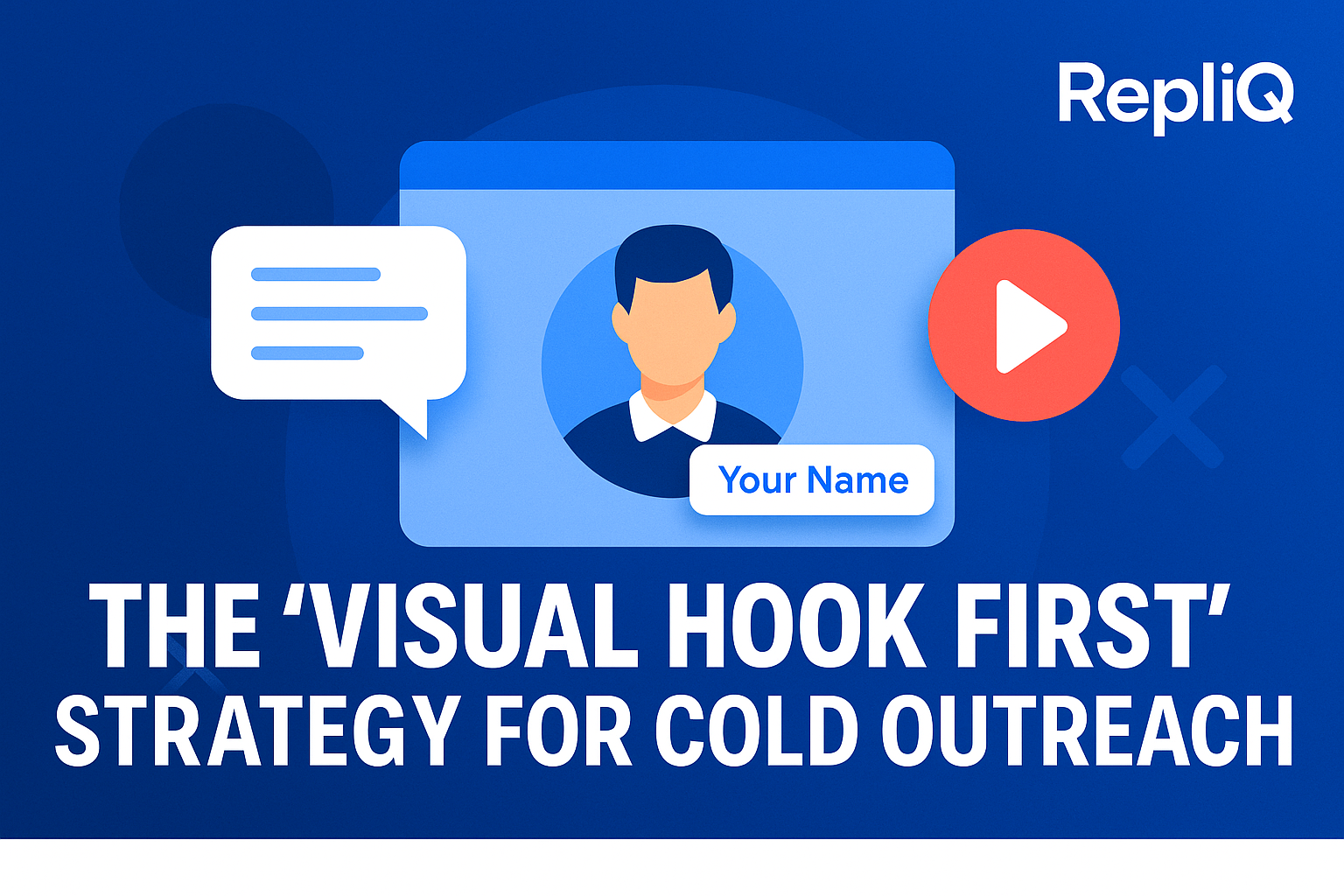
Visual-First Outreach: The Contrarian Blueprint for Winning Attention Before Text
Here is the uncomfortable truth most outbound teams ignore: your copy is usually not losing because it is weak. It is losing because it never earns attention in the first place.
In crowded inboxes and noisy LinkedIn feeds, prospects decide whether to engage with your message before they read a single full paragraph. The first conversion event in cold outreach is not the reply—it is attention. That is exactly why the visual hook should come before the text.
A visual first outreach strategy serves as the ultimate pattern interrupt. While traditional text-heavy outreach gets ignored, an image first strategy proves relevance in a fraction of a second. Why do images outperform text in cold outreach? Because they respect the buyer’s time, replacing paragraphs of context with instant visual proof.
This guide breaks down exactly what visual-first outreach is, which visual formats actually convert, how to pair images with concise copy, and how to scale this workflow without looking fake. At RepliQ, we have seen firsthand how integrating AI images into visual-first prospecting workflows dramatically shifts engagement metrics—proving that this is not just theory, but a highly executable outbound strategy. It represents the perfect middle ground: far more effective than copy-first messaging that gets skimmed, and much faster to scale than full video personalization.
To explore more outbound strategies and personalization breakdowns after reading this guide, visit our https://repliq.co/blog.
Table of Contents
- Why Text-Heavy Outreach Gets Ignored
- What Visual-First Outreach Actually Means
- Which Visual Hooks Work Best
- How to Pair Images with Short Supporting Copy
- How to Scale Without Losing Authenticity
- Tools, Workflow, and Measurement
- Future Trends & Expert Predictions
- Conclusion
- FAQ
Why Text-Heavy Outreach Gets Ignored
Attention scarcity, not copy length alone, is the true bottleneck in modern cold outreach. When a prospect opens an email or a direct message, they are not looking for a reason to read; they are looking for a reason to delete.
Most cold emails and LinkedIn messages fail because they look interchangeable. A block of text is visually generic and cognitively expensive to process. Prospects make snap judgments in mere seconds, relying on immediate relevance signals to decide if a message is worth their time. Even if you have written brilliant, highly personalized messaging, "good copy" routinely underperforms if it fails to interrupt visual sameness.
Founders, sales leaders, and growth operators do not want more paragraphs; they need faster proof of relevance. Text-heavy outreach often feels automated even when it is painstakingly personalized because the sender's effort is not instantly visible. As noted in research on first impressions from profile photos, human beings form complex judgments from visual cues in milliseconds. If your crowded inbox cold outreach relies entirely on words, you are fighting human biology. A text heavy cold email ignored by a prospect is rarely a rejection of your offer—it is a rejection of your format.
The First Three Seconds Matter More Than the Rest of the Message
In cold outreach, prospects do not read; they scan. The first three seconds dictate the fate of your message. A visual hook cold outreach strategy works because an image can compress complex context infinitely faster than a sentence can.
Pattern interruption is not about being randomly novel or flashy. It is about making relevance immediately visible. When a prospect sees an attention-grabbing outreach asset that clearly reflects their own business or profile, cold outreach engagement spikes because the brain instantly recognizes, "This is about me."
Why Better Copy Alone Usually Fails
Copy-first outreach operates on a flawed assumption: that the prospect will generously invest their attention to decode your message. Long introductions, multi-sentence personalization paragraphs, and standard "quick question" formats all collapse into the exact same visual pattern.
Better copywriting is vital, but it cannot do all the heavy lifting. Text should validate the premise and direct the action after attention is won. If you are struggling with cold email response rate improvement, trying to figure out how to prove personalization quickly in outreach using only words is a losing battle.
What Visual-First Outreach Actually Means
Visual-first outreach uses an image, thumbnail, screenshot, or lightweight visual asset to communicate relevance before the recipient reads the supporting text.
This is not about sending random images or replacing sales messaging with graphic design. It is a calculated method of earning micro-conversions—an open, a pause, a click, or a profile view—that ultimately lead to a reply. The visual wins the attention, the copy explains the context, and the call-to-action moves the conversation forward.
According to WHO guidance on visual communication, visuals significantly improve the understandability and uptake of complex information. In a personalized image outreach campaign, the visual first outreach strategy leverages this exact principle, turning abstract value propositions into tangible, instantly recognizable proofs of effort.
The Visual-First Framework: The image earns the pause. The copy confirms the relevance. The CTA directs the action.
The Difference Between Copy-First, Visual-First, and Video-First Outreach
Understanding where visual-first sits in the outbound ecosystem is critical:
- Copy-first: Easiest to send, hardest to notice. Highly scalable but suffers from low engagement.
- Visual-first: The fastest relevance signal with highly scalable effort. The optimal sweet spot for modern outbound teams.
- Video-first: Highest richness and personalization, but often too slow and expensive to scale effectively.
When comparing visual first outreach vs video personalization, visual-first provides the immediacy of a video thumbnail outreach for sales but without the heavy production bottleneck, making personalized image outreach highly practical.
What Counts as a Visual Hook
A visual hook can be an annotated screenshot, a personalized thumbnail, a homepage teardown, a name or company overlay, a profile-based mockup, or an offer preview.
The best images for prospecting outreach instantly communicate that the message was crafted specifically for the recipient. However, teams must avoid overly polished visuals that look like B2B ad creative. The visual must look like human outreach, utilizing legally accessible, public information. To see how outbound teams generate these lightweight visual assets efficiently, explore how to create them at scale with https://repliq.co/ai-images. Thumbnail personalization and targeted prospecting visuals are only effective when they remain authentic.
Which Visual Hooks Work Best
Not every visual performs the same. The best visual format depends entirely on your channel, your offer, and how quickly the image signals relevance. "Works best" does not mean the most colorful or novel; it means the fastest comprehension combined with authentic relevance.
Whether you are executing a personalized image outreach campaign or testing a new visual hook cold outreach sequence, selecting the right format is the difference between a booked meeting and a deleted message.
Annotated Screenshots
Annotated screenshots are incredibly effective because they provide undeniable proof that you actually looked at the prospect’s website, product, funnel, or public profile.
Use cases include highlighting a missing call-to-action, pointing out an onboarding friction point, or dropping a positioning note on a homepage. Annotations should be minimal and directional—like a simple red arrow or a drawn circle—not cluttered. Annotated screenshots are the ultimate sales prospecting personalization tool, especially when learning how to use a visual hook in cold email tied to a concrete, actionable suggestion.
Personalized Thumbnails and Name/Company Overlays
Lightweight visual personalization involves placing a prospect's first name, company name, or logo contextually onto an image or thumbnail.
This creates immediate "this was made for me" recognition without requiring a fully custom asset for every lead. However, a warning: superficial overlays that lack true message relevance can feel gimmicky. The image personalization for sales outreach must tie directly into the core value proposition. When done right, thumbnail personalization elevates standard cold email images into high-converting assets.
Website Teardowns and Mockups
For agencies, consultants, and SaaS founders, mockups and mini-teardowns make your value proposition visible rather than abstract.
These prospecting visuals should preview the value, not dump a comprehensive audit into the prospect's inbox. Showing a quick "before and after" mockup of a landing page or an ad creative serves as a brilliant piece of attention-grabbing outreach. These personalized cold outreach examples instantly validate your expertise.
Video Preview Thumbnails Without Full Video Production
You do not always need to record a full video to reap the benefits of video outreach. A video thumbnail outreach strategy can deliver the curiosity and relevance benefits of video at a fraction of the production cost.
Using a play button overlay on a personalized image acts as a strategic stepping stone between static visual first outreach vs video personalization, making video thumbnail outreach for sales a highly efficient hybrid approach.
Channel Fit — Email vs LinkedIn
The channel dictates the visual framing. Email typically rewards cleaner, more direct visuals (like a crisp cold email images or mockups). LinkedIn visual prospecting, on the other hand, benefits from social-native imagery, such as profile-context screenshots or casual, human-centric thumbnails. Adjusting your visual assets for multichannel outbound ensures your hooks feel native wherever the prospect encounters them.
How to Pair Images with Short Supporting Copy
The golden rule of visual-first outreach is simple: the image earns the pause, but the copy confirms relevance and directs the next step.
Supporting text must be concise, specific, and incredibly easy to process. If your copy is generic, long-winded, or self-centered, it will kill the momentum generated by a strong visual. According to CDC guidance on using visuals with clear copy, visuals are most effective when paired with simple, non-distracting language. Furthermore, CDC guidance on visual cues and message emphasis reinforces that the main message must be emphasized quickly to retain reader attention.
A Simple Formula for Visual-First Messaging
When figuring out how to use a visual hook in cold email, use this highly tactical formula:
- The Visual: Provides immediate context.
- Sentence One: Explains exactly why this matters to them.
- Sentence Two: Suggests a low-friction next step.
By keeping the short supporting copy tight, you master how to prove personalization quickly in outreach, ensuring your visual first outreach strategy maintains momentum.
What the Copy Should Do After the Visual
Your copy should name the relevance, reduce ambiguity, introduce your observation or offer, and ask for a simple next step. It should reinforce the visual, not redundantly describe it. This alignment is what drives high cold outreach engagement and makes sales prospecting personalization feel seamless in personalized image outreach.
Common Mistakes When Pairing Visuals and Text
The most common failure cases include:
- Repeating in text what the image already clearly shows.
- Writing a massive paragraph underneath a simple visual (resulting in a text heavy cold email ignored by the prospect).
- Relying on blind curiosity without providing clarity.
- Adding too many visual or verbal elements at once.
Avoid spammy looking outreach images by keeping your visuals professional and your text brutally concise. Attention-grabbing outreach relies on clarity, not confusion.
How to Scale Without Losing Authenticity
The biggest objection to visual-first outreach is the perceived difficulty of scaling it. Scale often strips away credibility when teams automate the wrong parts of the process.
The goal is not handcrafted, artisanal perfection for every single lead; the goal is believable relevance within repeatable, compliant systems. Teams can standardize templates and data inputs while preserving context-specific meaning. At RepliQ, we rely heavily on AI-assisted image generation to help teams execute visual personalization workflows without jumping straight to heavy video production. You can explore how to build these workflows at https://repliq.co/ai-images.
What to Standardize vs What to Personalize
To master how to scale image first outreach, you must divide your workflow:
- What to Template: The layout structure, annotation style, CTA placement, and brand-safe visual rules.
- What to Personalize: The prospect's context, the specific observation, the relevant offer angle, and the channel framing.
This division allows for dynamic image personalization that feels bespoke but operates like a scalable personalized image outreach machine.
How to Avoid Looking Automated, Gimmicky, or Creepy
Authenticity comes from relevance and restraint, not from utilizing the maximum number of personalization tokens.
- Do not over-personalize trivial data.
- Do not use novelty visuals that lack business relevance.
- Do not make the image feel manipulative or surveillance-heavy; only use legally compliant, publicly accessible data.
- Keep the asset genuinely useful.
Following these guardrails ensures you avoid spammy looking outreach images and maintain high-quality sales prospecting personalization through your prospecting visuals.
A Lightweight Workflow for Teams
Operationalizing an image first strategy requires a simple, repeatable process:
- Define your segment.
- Choose the visual hook type.
- Create the visual template.
- Add personalized context.
- Pair with short copy.
- Test by channel.
This multichannel outbound workflow is the blueprint for how to scale image first outreach effectively.
Tools, Workflow, and Measurement
To make this strategy operational, you must measure the right things. Teams should not only measure final replies; they must track intermediate behaviors that reveal whether the visual is actually doing its job.
Different tools support different parts of this workflow, from visual generation and personalization to outreach sequencing and analytics. Unlike heavy video-only setups or generic mail-merge text, a visual-first approach utilizes AI enrichment and lightweight production to give you a measurable, practical advantage.
What to Measure in Visual-First Outreach
Do not rely solely on top-line reply rates. Track micro-conversions:
- Did they open the message?
- Did they click or view the image?
- Did they watch the thumbnail preview?
- Did they reply faster than average?
- Did the overall reply quality improve?
Tracking these micro-conversions provides a clearer picture of your cold outreach engagement and is the secret to sustained cold email response rate improvement.
How to Test Visuals vs Copy
To isolate whether your image is earning attention or your copy is rescuing a weak visual, run structured A/B testing outreach visuals:
- Same copy, different visual.
- Same visual, different supporting text.
- Static image vs. video thumbnail.
- Email-only vs. email + LinkedIn sequence.
This discipline refines your visual hook cold outreach and optimizes your personalized image outreach over time.
When to Use Static Visuals vs Personalized Video
Use this decision matrix:
- Static visuals: For scale, speed, and initial pattern interruption.
- Personalized video: For high-value target accounts or later-stage follow-ups.
- Thumbnail-led outreach: As a hybrid option bridging the gap.
Understanding visual first outreach vs video personalization allows you to deploy video thumbnail outreach for sales exactly when it is most effective, maximizing your personalized image outreach efforts.
Future Trends & Expert Predictions
The outbound landscape is shifting rapidly. AI-assisted image generation and dynamic personalization at scale are making it easier than ever to deploy contextual visuals. We are moving toward a future dominated by dynamic overlays pulled from prospect data, highly integrated multichannel visual prospecting, and an increase in thumbnail-led, short-form preview assets.
Lightweight visual personalization is set to become the default bridge between plain text and full video outreach. However, as more teams adopt LinkedIn visual prospecting and image-based emails, the winning edge will shift away from mere novelty. The victors will be those who prioritize quality, speed, and hyper-relevance.
Conclusion
In cold outreach, text is undeniably important, but attention always comes first. Visuals are the fastest, most effective way to earn that attention.
Text-heavy outreach gets ignored because it demands too much cognitive effort upfront. Visual-first outreach, by contrast, makes relevance visible immediately. The best visual hooks are simple, highly contextual, and channel-appropriate. When you pair these visuals with concise copy that supports rather than competes with the image, you create an unstoppable outbound sequence. And with the right systems in place, this strategy scales beautifully without ever stripping away authenticity.
If your outreach still relies on massive paragraphs to prove personalization, you are making your prospects work far too hard. Stop hiding your relevance behind walls of text.
At RepliQ, our hands-on focus on visual-first prospecting workflows proves that earning attention is a science you can automate. Discover how AI-generated personalized visuals can help you operationalize this strategy at scale by visiting https://repliq.co/ai-images. To continue mastering your outbound approach, read more on our https://repliq.co/blog.
FAQ
What is visual-first outreach?
Visual-first outreach is an outbound methodology that uses an image, thumbnail, or screenshot to immediately communicate relevance and capture a prospect's attention before they read any text. In this image first strategy, the visual leads the attention, while the concise supporting text drives comprehension and action.
Why do images outperform text in cold outreach?
Visuals are processed by the human brain exponentially faster than text, creating an immediate pattern interrupt. They prove personalization instantly, bypassing the need for explanatory paragraphs. As supported by research on profile images in B2B first contact, visual cues heavily influence first-response behavior, making a visual hook cold outreach strategy highly effective, though results will naturally vary based on execution and channel.
What types of images work best for prospecting?
The best images for prospecting outreach include annotated screenshots, personalized thumbnails, website teardowns, and simple, context-rich mockups. The ideal format always depends on your specific offer, your audience, and whether you are sending cold email images or deploying social-native prospecting visuals.
How personalized does an image need to be?
Useful relevance always beats maximal personalization. You do not need to overload an image with custom data points; instead, aim for immediate context recognition. The goal of personalized image outreach is to show you understand their current situation, which is the ultimate key to how to prove personalization quickly in outreach.
Can visual-first outreach scale without losing authenticity?
Yes, absolutely. Teams can scale visual-first outreach by templating the structural format (like layout and design rules) while dynamically personalizing the context (like the prospect's website or name). By leveraging AI-assisted workflows and strict quality control, you can master how to scale image first outreach using dynamic image personalization without ever looking automated or fake.

.svg)
.png)


.svg)